









Pronunciation: man-SOO-rah-SOR-us
Meaning: Mansoura Lizard
Author/s: Sallam et al. (2018)
Synonyms: None known
First Discovery: Dakhla Oasis, Egypt
Acta Ordinal: #998
Mansourasaurus shahinae
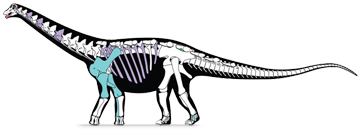
Mansourasaurus shahinae hails from the late Campanian rocks of Egypt’s Western Desert, and represents the most complete African dinosaur specimen currently known from the PPC (post-Cenomanian Cretaceous—94-66 million years ago) of the African mainland. This medium-sized titanosaur—about the weight of a modern elephant—was preserved as a partial skeleton including skull fragments, neck and back vertebrae, ribs, limb bones, and even pieces of dermal armor, but the bone surfaces still showed the open sutures of an animal not yet fully grown. Its remains, drawn from the Quseir Formation, anchor a rare glimpse of life in a region whose Late Cretaceous fossil record is famously sparse.
The anatomy of Mansourasaurus reveals a dinosaur still connected to the wider world. Detailed comparisons show it shares more features with European titanosaurs than with those from South America, suggesting that northern Africa retained biogeographic ties to Eurasia even as the continents drifted toward their final Cretaceous positions. Named for Mansoura University and honoring Mona Shahin, a founder of its vertebrate paleontology center, the discovery marks a turning point: a well-preserved, well-dated sauropod that helps clarify how African ecosystems evolved in the final chapters before the end-Cretaceous extinction.
The anatomy of Mansourasaurus reveals a dinosaur still connected to the wider world. Detailed comparisons show it shares more features with European titanosaurs than with those from South America, suggesting that northern Africa retained biogeographic ties to Eurasia even as the continents drifted toward their final Cretaceous positions. Named for Mansoura University and honoring Mona Shahin, a founder of its vertebrate paleontology center, the discovery marks a turning point: a well-preserved, well-dated sauropod that helps clarify how African ecosystems evolved in the final chapters before the end-Cretaceous extinction.
(Shahin's Mansoura lizard)Etymology
Mansourasaurus is derived from "Mansoura" (for Mansoura University: home institution of the research collaborative that undertook the field and laboratory work) and the Greek "sauros" (lizard).
The species epithet, shahinae, honours Ms. Mona Shahin for her integral role in developing the Mansoura University Vertebrate Paleontology (MUVP) initiative.
ZooBank registry: urn:lsid:zoobank.org:act:81FD8987-8020-4C57-AABF-13DE9A9BB819.
Discovery
The remains of Mansourasaurus were discovered in the upper member of the Quseir Formation at Dakhla Oasis, north of the road between Mut and Bala, in the Western Desert of Egypt, during a Dr Hesham Sallam-led expedition from Egypt's Mansoura University.
The holotype (MUVP 200) includes parts of the skull, the lower jaw, three neck and two back vertebrae with associated ribs, most of a shoulder girdle and part of a forelimb, a partial foot, pieces of armour plates, and several unidentified fragments.
Preparators
Iman El-Dawoudi and Sanaa El-Sayed.


