




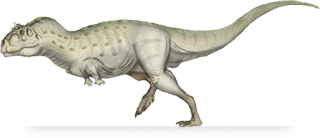
Pronunciation: IN-do-SOR-us
Meaning: Indian Lizard
Author/s: Huene and Matley (1933)
Synonyms: Megalosaurus matleyi
First Discovery: Madhya Pradesh, India
Acta Ordinal: #173
Indosaurus matleyi
Indosaurus has caused palaeontologists nightmares ever since its remains were discovered by Charles Alfred Matley between 1917 and 1919 in the "dinosaur bed" (a site in India's Lameta Formation spanning no more than 20 square yards), along with ten other dinosaurs that have since been named, and they are all based on scrappy remains that aren't particularly well preserved.
In 1933, Friedrich von Huene described its meagre remains and assigned them to Allosauridae. But its "extremeley thickened" [sic] skull bones were later moved to Abelisauridae 'cos features of said skull hinted at the presence of horns like fellow abelisaurid Carnotaurus, but this is hard to prove since its holotype remains, and thus all evidence, has been lost.
If Indosaurus is related to South America's "meat-eating bull", then India may not have been a separate continent for the last 100 million years as many palaeontologists had thought, and it's possible instead that the two land masses were still connected intermittently by land bridges, allowing dinosaurs from both areas to migrate as "recently" as 70 million years ago.
As research plods on, we suspect that many of the Lameta theropods will be sunk into each other, trimming the current eleven down to two or possibly three. Megalosaurus matleyi has already been referred to Indosaurus, and Indosuchus and Compsosuchus may belong there too. Furthermore, some palaeontologists reckon the differences between Indosaurus, Rajasaurus and Lametasaurus are merely artefacts of preservation, and if they do represent three specimens of the same critter, then the latter would be the only valid name as it was coined first.
In 1933, Friedrich von Huene described its meagre remains and assigned them to Allosauridae. But its "extremeley thickened" [sic] skull bones were later moved to Abelisauridae 'cos features of said skull hinted at the presence of horns like fellow abelisaurid Carnotaurus, but this is hard to prove since its holotype remains, and thus all evidence, has been lost.
If Indosaurus is related to South America's "meat-eating bull", then India may not have been a separate continent for the last 100 million years as many palaeontologists had thought, and it's possible instead that the two land masses were still connected intermittently by land bridges, allowing dinosaurs from both areas to migrate as "recently" as 70 million years ago.
As research plods on, we suspect that many of the Lameta theropods will be sunk into each other, trimming the current eleven down to two or possibly three. Megalosaurus matleyi has already been referred to Indosaurus, and Indosuchus and Compsosuchus may belong there too. Furthermore, some palaeontologists reckon the differences between Indosaurus, Rajasaurus and Lametasaurus are merely artefacts of preservation, and if they do represent three specimens of the same critter, then the latter would be the only valid name as it was coined first.
(Matley's Indian Lizard)Etymology
Indosaurus is derived from the Greek "Indos" (India) and the Greek "sauros" (lizard). The species epithet, matleyi, honors British geologist Charles Alfred Matley.
Discovery
The remains of Indosaurus were discovered in the "Carnosaur bed" of the Lameta Formation, on the estate of a gun carriage factory at Bara Simla Hill, near Jabalpur (aka Jubbulpore), Narmada Valley, Madhya Pradesh, India, by Matley and Durgasankar Bhattacharji between 1917 and 1919.
Specimen GSI IM K27/565 (the rear portion of a skull) was described by von Huene and Matley in 1933, and Chatterjee declared it as the holotype in 1978. Many more abelisaurid remains have been discovered in the "dinosaur bed" but none of them can be referred to Indosaurus for two reasons: (1) they're lack overlapping parts for comparison, and (2) the holotype is now lost so there is nothing to physically compare new remains to.


