




Pronunciation: ih-zah-BEH-ree-SOH-ruh
Meaning: Isabel Berry's lizardess
Author/s: Salgado, et al. (2017)
Synonyms: None known
First Discovery: Neuquén, Argentina
Acta Ordinal: #961
Isaberrysaura mollensis
Compared to the rest of the world, the record of Jurassic-aged neornithischians in South America is poor to say the least, but Isaberrysaura came out throwing hay-makers left, right and centre in 2017. It was hailed as the first neornithischian dinosaur known from the Jurassic of South America, the first dinosaur recovered from Argentina's Middle Jurassic Los Molles Formation, and preserved gut contents—an anatomical jackpot almost never seen outside Ornithopoda. It's also one of the rare dinosaurs to carry the feminine suffix -saura, and for a moment, it looked like she was about to anchor a whole new chapter in southern-hemisphere neornithischian evolution.
........
........
(Isabel Berry's Lizardess from Los Molles)Etymology
Isaberrysaura is derived from "Isa Berry" (for Isabel Valdivia Berry, who reported the initial discovery) and the Greek "saura", the feminine form of the masculine "sauros" (lizard).
The species epithet, mollensis, means "from Molles" in Latin, referring to the Los Molles locality.
Discovery
The remains of Isaberrysaura were discovered in the Los Molles Formation, Neuquén Province, Argentina, by Isabel Valdivia and Erico Otilio Berry. The holotype (MOZ-Pv 6459) is a nearly complete skull (an estimated 52cm in length and 20cm across its widest point, and almost as high as it is wide) and an as-yet unprepared partial skeleton, which includes six neck (cervical) vertebrae, fifteen back (dorsal) vertebrae, a chunk of hip consisting of a sacrum with a partial ilium and an apparently complete pubis, nine tail (caudal) vertebrae, part of a shoulder blade (scapula), ribs, and some unidentifiable fragments.
Preparator
Débora Palledini.
Gut contents
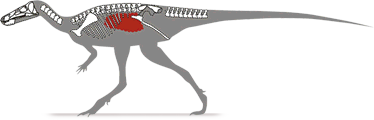
Isaberrysaura preserved evidence of its last meal in the form of a mass of mineralised seeds in the middle-rear of its stomach cavity, which is a rare find for any dinosaur, and virtually unheard of outside of Ornithopoda.
Identified as belonging to an extinct species of the Cycadales family of plants, the larger fossil seeds were in the early stages of digestion and had been gobbled down but not chewed, as they still preserved the entire sarcotesta, a toxic fleshy layer that would hold no fear for animals as large as dinosaurs: a notion based mainly on modern cycad seeds that are swallowed whole, toxins and all, but hold no fear for large mammals such as elephants. But beneath the sarcotesta, in both extinct and extant cycad seeds, is the sclerotesta: a hard undigestible layer which protects the endosperm on the perilous journey from the mouth, through the intestinal tract, and out the other end along with natural fertilizer. Then they would sprout in their own sweet time, far away from where they were consumed.
That is a 171-167 million year old example of reciprocal back-scratching, where critters who had to feed, and plants that needed to sow their seed, worked in perfect harmony.
Unfortunately, the smaller seeds have yet to be identified.


