









Pronunciation: EE
Meaning: Wing
Author/s: Xu et al. (2015)
Synonyms: None known
First Discovery: Hebei Province, China
Acta Ordinal: #908
Yi qi
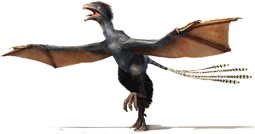
It was long assumed that bona fide birds and the non-bird theropod dinosaurs with feathery forelimbs shared at least a similar basic wing plan, which you would expect, bearing in mind the former are the last living representatives of the latter. Yi qi, however, has a weird bony prong protruding from each wrist that is considerably longer than its forearm (which itself is longer than its lower leg) and is unknown in any bird or dinosaur, theropod or otherwise. Furthermore, rippled sheets of membranous tissue are preserved in patches between said prongs and the long digits of the hand, so although a theropod dinosaur with a complete body covering of feathers, the wings of Yi (and probably all scansoriopterygids) appear to be more like those of bats and other flying or gliding mammals than those of birds.
Although the skull and forelimb proportions of Yi qi broadly resemble those of other scansoriopterygids, the details reinforce just how unconventional this animal was. The snout is short and blunt, with the bone at the tip of the upper jaw sitting lower than the bone behind it and the robust lower jaw following the same downwards curve, while the front teeth tilt forward in a way that hints at a feeding style centred on snagging insects and perhaps probing or nipping at soft food items. The shoulder girdle and upper arm bones are sturdy, but the shoulder?muscle ridge on the upper arm is surprisingly short, suggesting that whatever motion powered its wings was not the strong, down-stroke-driven flapping seen in early birds. Of its three fingers, the outermost is the longest by far, and reinforced, no doubt to help tension the membrane stretched between the digits and the wrist rod.
Taken together, these features point to an animal that was almost certainly a tree-dweller, using its long limbs and recurved claws to clamber through forest canopies. In that setting, a membranous wing would have been ideal for controlled gliding between trunks and branches, much like modern colugos or flying squirrels. The discovery of Ambopteryx with a similar arrangement shows that Yi qi was not a lone experiment but part of a brief Jurassic radiation of anatomically adventurous dinosaurs exploring a flight pathway entirely separate from the feather-based route that ultimately led to our modern flying friends.
Although the skull and forelimb proportions of Yi qi broadly resemble those of other scansoriopterygids, the details reinforce just how unconventional this animal was. The snout is short and blunt, with the bone at the tip of the upper jaw sitting lower than the bone behind it and the robust lower jaw following the same downwards curve, while the front teeth tilt forward in a way that hints at a feeding style centred on snagging insects and perhaps probing or nipping at soft food items. The shoulder girdle and upper arm bones are sturdy, but the shoulder?muscle ridge on the upper arm is surprisingly short, suggesting that whatever motion powered its wings was not the strong, down-stroke-driven flapping seen in early birds. Of its three fingers, the outermost is the longest by far, and reinforced, no doubt to help tension the membrane stretched between the digits and the wrist rod.
Taken together, these features point to an animal that was almost certainly a tree-dweller, using its long limbs and recurved claws to clamber through forest canopies. In that setting, a membranous wing would have been ideal for controlled gliding between trunks and branches, much like modern colugos or flying squirrels. The discovery of Ambopteryx with a similar arrangement shows that Yi qi was not a lone experiment but part of a brief Jurassic radiation of anatomically adventurous dinosaurs exploring a flight pathway entirely separate from the feather-based route that ultimately led to our modern flying friends.
(Strange wing)Etymology
In Mandarin, Yi (pronounced EE) means "wing" and the species epithet qi (pronounced chee) means "strange".
Yi took the title of shortest generic dinosaur name from fellow Asian theropods Mei and Kol. With just two letters,
Discovery
The remains of Yi were discovered in the Tiaojishan Formation near Mutoudeng Village, Qinglong County, Hebei Province, China, by Mr. Jianrong Wang. Being a farmer, he never bothered logging collection data, but the specimen's provenance and authenticity were confirmed by a series of stringent tests including CT scans, and sampling and comparisons of the sediment in which it was encased. The holotype (STM 31-2, housed at the Shandong Tianyu Museum) is a partial skeleton, including a robust and short-snouted skull (snout = approximately 40% of skull length), and associated soft tissue, preserved on a slab and counter-slab
Preparator
X. Ding.


