
GYPOSAURUS
a dubious sauropodomorph dinosaur from the Early Jurassic of South Africa.
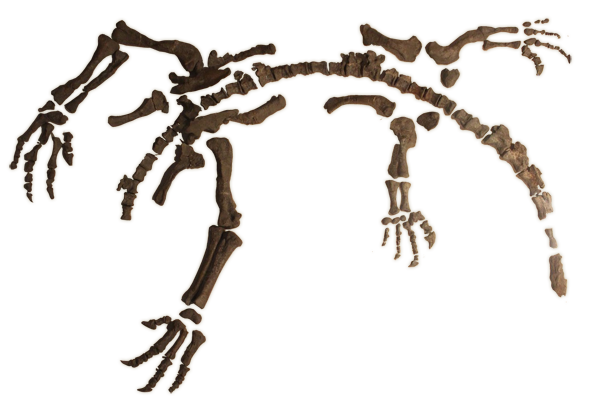
Pronunciation: JIP-o-SOR-us
Meaning: Vulture lizard
Author/s: Broom (
1911)
Synonyms: 'Gripposaurus' (Barrett
et al., 2007)
First Discovery: Free State, South Africa
Acta Ordinal: #103
Gyposaurus capensis
Not to be confused with
Gryposaurus,
Gyposaurus—"Vulture Lizard"—is a genus of basal sauropodomorph dinosaur from the early Jurassic of South Africa (and possibly China) that has spent a large chunk of its life-after-death being mentioned as a juvenile specimen of other "prosauropods".
It was initially assigned to
Hortalotarsus skirtopodus in 1906 by Scottish physician and palaeontologist Robert Broom, who thought it was a juvenile due to its more modest size. But when Friedrich Von Huene referred
Hortalotarsus to
Thecodontosaurus in 1906, Broom reclaimed his critter because of the unique features of its hip and thigh, and he christened it
Gyposaurus capensis in 1911.
Galton and Cluver tried to sink
Gyposaurus into
Anchisaurus in 1976 but few followed, and most have accepted that Michael Cooper was right to synonymize it with
Massospondylus in 1981.
(Vulture Lizard from Cape Town Museum)Etymology
Gyposaurus is derived from the Greek "gyp-" (vulture) and "sauros" (lizard), referring to the outdated hypothesis that prosauropods were carnivorous.
The
species epithet,
capensis,
is derived from "cape" and the Latin "-ensis" (from). As Broom didn't specify the meaning, it would be easy to assume that the "Cape" refers to Cape Colony, but the fossil itself was not collected there. Instead, the name most plausibly reflects the curatorial geography: the specimen had been presented to, and was housed in, the South African Museum in Cape Town.
Discovery
The remains of
Gyposaurus capensis were discovered in the Cave Sandstone of the Upper Elliot Formation (Stormberg Series) near Ladybrand, in what Broom (1906) referred to as the O.R.C. (the Orange River Colony, formerly the Orange Free State, and today the Free State Province) of South Africa.
The
holotype (originally SAM 990, now SAM-PK-K-990), obtained by Mr. Alex Moir and subsequently presented to the South African Museum, Cape Town, is a partial skeleton consisting of eleven back and six tail vertebrae, ribs, gastralia, a partial right shoulder blade, a fairly complete pelvic girdle (both pubes and ischia, and the right ilium), and most of a right leg.
Estimations
Timeline:
Era: Mesozoic
Epoch: Early Jurassic
Stage: Simemurian-Pliensbachian
Age range: 196-189 mya
Stats:
Est. max. length: ?
Est. max. hip height: ?
Est. max. weight: ?
Diet: Herbivore
Gyposaurus sinensis
Gyposaurus sinensis was named by Yang Zhongjian (better known as C.C. Young) in 1941 for four specimens (IVPP AS V.24 and V.25, which have since been lost, and V.26 and V.27) from the Lower Jurassic Lufeng Formation of Yunnan Province, China. In 1976, Peter Galton reassigned these specimens to
Lufengosaurus as juveniles, and Zhiming Dong transferred them to
Anchisaurus in 1992, though neither referral gained much traction.
In a 2004 review of "Prosauropoda", Galton and Upchurch regarded
Gyposaurus sinensis as a valid and distinct critter, but with the
Gyposaurus name-bearer assumed to be a specimen of
Massospondylus, it needed a name of its own. Barrett and colleagues obliged in 2007 by proposing "Gripposaurus", which was a textbook example of how not to introduce a new genus: (1) they wrapped it in scare quotes to float the name without commiting to it, (2) they applied the name to a specimen that Young had referred to
Gyposaurus sinensis in 1948 rather than to the 1941 type series, but didn't include a specimen number, and (3) they provided no diagnosis, description, or justification under the new name, leaving "Gripposaurus" tripley unofficial and as naked as a nomen nudum can be.
During a 2017 conference presentation, Wang and colleagues agreed with Galton (1976) and suggested that "
Gyposaurus"
sinensis is likely a juvenile of
Lufengosaurus huenei, but that came with some baggage of its own: (1) their analysis remains unpublished, and (2) several referred specimens of "
Gyposaurus"
sinensis do need further investigation.
Gyposaurus erectus
In 1920, Egbert Cornelis Nicolaas van Hoepen named
Aristosaurus erectus, based on an almost complete skeleton found by quarry workers on a slab and counter part (TM 130) near Roosendal, Senekal District, Ficksburg, Free State, South Africa, probably in the Clarens Formation (Stormberg Series). Twelve years later, Friedrich
Von Huene sank
Aristosaurus erectus into synonymy with
Gyposaurus capensis, and that view was followed by the likes of Romer (1956), Charig (1967), Steel (1970), and White (1973).
When Galton and Cluver announced
Gyposaurus as a synonym of
Anchisaurus in 1976, they also argued that
Aristosaurus should never have been placed in
Gyposaurus at all, as it represents a valid and distinct "broad-footed prosauropod" in its own right. However, like
Gyposaurus capensis, Michael Cooper (1981) identified
Gyposaurus erectus as a specimen of
Massospondylus, and more recent studies have listed it as a dubious sauropodomorph.
References
• Seeley HG (1894) "
LIII.—On Hortalotarsus skirtopodus, a new Saurischian fossil from Barkly East, Cape Colony".
Annals and Magazine of Natural History, Series 6, 14(84): 411-419. DOI: 10.1080/00222939408677828.
• Broom R (1906) "
On the South African dinosaur (Hortalotarsus)".
Transactions of the South African Philosophical Society, 16(3): 201-206.
• Huene Fv (1906) "
Über die Dinosaurier der aussereuropäischen Trias" [About the dinosaurs from the Triassic outside of Europe].
Geologische und Paläontologische Abhandlungen. New Series, 8: 97–156.
• Broom R (1911) "
On the dinosaurs of the Stormberg, South Africa".
Annals of the South African Museum, 7(4): 291-308.
• Van Hoepen ECN (1920) "A new dinosaur from the Stormberg Beds".
Annals of the Transvaal Museum. Contributions to the knowledge of the reptiles of the Karroo Formation, 7(2): 77–92.
• Huene Fv (1932) "Die fossile Reptil-Ordnung Saurischia, ihre Entwicklung und Geschichte" [The fossil reptile order Saurischia, their development and history].
Monographien zur Geologie und Palaeontologie, Serie 1, 4(1-2): 1-361.
• Yang Z (1940) "Preliminary notes on the Lufeng vertebrate fossils".
Bulletin of the Geological Society of China, 20(3-4): 235-240. DOI: 10.1111/j.1755-6724.1940.mp203-4003.x.
• Young C-C (1941) "
Gyposaurus sinensis Young (sp. nov.) a new Prosauropoda from the Upper Triassic beds at Lufeng, Yunnan".
Bulletin of the Geological Society of China, 21 (2-4): 205-252. DOI: 10.1111/j.1755-6724.1941.mp212-4005.x.
• Young C-C (1948) "Further notes on
Gyposaurus sinensis Young".
Bulletin of the Geological Society of China, 28: 91-103.
• Charig AJ (1967) "Archosauria". In "The Fossil Record. A symposium with documentation".
Geological Society of London Special Publication, 2: 703-718.
• Galton PM and Cluver MA (1976) "
Anchisaurus capensis (Broom) and a revision of the Anchisauridae (Reptilia, Saurischia)".
Annals of the South African Museum. 69(6): 121-159.
• Galton PM (1976) "
Prosauropod dinosaurs (Reptilia: Saurischia) of North America".
Postilla, 169: 1-98.
• Cooper MR (1981) "The prosauropod dinosaur
Massospondylus carinatus Owen from Zimbabwe: its biology, mode of life and phylogenetic significance".
Occasional Papers of the National Museums and Monuments of Rhodesia, Series B, Natural Sciences, 6(10): 689-840.
• Dong Z (1992) "
Dinosaurian faunas of China".
• Galton PM and Upchurch P (2004) "Prosauropoda". Page 232–258 in Weishampel, Dodson and Osmólska (eds.) "
The Dinosauria: Second Edition".
• Barrett PM, Upchurch P, Zhou XD and Wang XL (2007) "
The skull of Yunnanosaurus huangi Young, 1942 (Dinosauria: Prosauropoda) from the Lower Lufeng Formation (Lower Jurassic) of Yunnan, China".
Zoological Journal of the Linnean Society, 150(2): 319-341. DOI: 10.1111/j.1096-3642.2007.00290.x.
• Wang YM, You HL, Otero A and Wang T (2017) "Taxonomy of "
Gyposaurus"
sinesis Young, 1941 from the Early Jurassic Lufeng Formation of Yunnan Province, southwestern China".
SVP 2017 Meeting Program and Abstracts. Society of Vertebrate Paleontology 77th Annual Meeting. Calgary: Society of Vertebrate Paleontology. Page 210.
• Barrett PM Chapelle KEJ, Staunton CK, Botha J and Choiniere JN (2019) "
Postcranial osteology of the neotype specimen of Massospondylus carinatus Owen, 1854 (Dinosauria: Sauropodomorpha) from the upper Elliot formation of South Africa".
Palaeontologia Africana, 53: 174.
• Wang YM, Zhao Q and You H-L (2024) "Reassessment of "
Gyposaurus"
sinensis Young, 1941 (Dinosauria: Sauropodomorpha) from the Early Jurassic Lufeng Basin, Yunnan Province, China".
Zoological Journal of the Linnean Society: zlae032.
DOI: 10.1093/zoolinnean/zlae032.
Time stands still for no man, and research is ongoing. If you spot an error, or want to expand, edit or add a dinosaur, please use
this form. Go
here to contribute to our FAQ.
All dinos are GM free, and no herbivores were eaten during site construction!
To cite this page:
Atkinson, L.
"
GYPOSAURUS :: from DinoChecker's dinosaur archive".
‹
http://www.dinochecker.com/dinosaurs/GYPOSAURUS›. Web access: 25th Oct 2026.









