




Pronunciation: AH-jih-li-SOR-us
Meaning: Agile lizard
Author/s: Peng (1990)
Synonyms: None known
First Discovery: Sichuan, China
Acta Ordinal: #351
Agilisaurus louderbacki
Despite being one of the most complete bird-hipped dinosaurs known to science, Agilisaurus has led paleontologists a merry-dance. Historically tangled with other small Dashanpu dinosaurs, it was initially listed as an ornithopod, first in Fabrosauridae (an unnatural grouping, since confined to the taxonominc wastebin) then as a member of Heterodontodsauridae (which aren't actually ornithopods). A stint in marginocephalia followed but latest research points to a position right at the foot of Neornithischia.
Funny thing Neornithischia. It contains the ornithopods and marginocephalians plus a small handful of basal critters which, when removed from the equation, leaves exactly the same members as Cerapoda. And despite the name (neo" means "new"), the new ornithischians mostly aren't, at least the non-ornithopod non-marginocephalian variety like Agilisaurus, as they all hail from the Early to Late Jurassic.
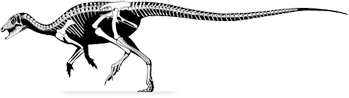
Agilisaurus had a short but high skull and a beak at the tip of its snout and lower jaw for shearing vegetation, though the prescence of short-pointy upper jaw canines and chisel-like cheek teeth has led some scientists to speculate that perhaps they weren't subsisting on vegetation alone. Shins much longer than thighs, a long counter-balancing tail and a gracile build suggest Agilisaurus was extremely fleet of foot, and scleral rings within its eyes indicate a diurnal lifestyle: it was active throughout the day then rested at night. Because it lacks tail-stiffening interwoven bony struts, some paleontologists think it may have been a burrow dweller.
In a extraordinary twist of fate, the one known specimen of Agilisaurus, lacking only bits of both left limbs, was hauled out of the Dashanpu Quarry in China's Lower Shaximiao Formation during construction of the Zigong Dinosaur Museum where it is now housed.
Funny thing Neornithischia. It contains the ornithopods and marginocephalians plus a small handful of basal critters which, when removed from the equation, leaves exactly the same members as Cerapoda. And despite the name (neo" means "new"), the new ornithischians mostly aren't, at least the non-ornithopod non-marginocephalian variety like Agilisaurus, as they all hail from the Early to Late Jurassic.
Agilisaurus had a short but high skull and a beak at the tip of its snout and lower jaw for shearing vegetation, though the prescence of short-pointy upper jaw canines and chisel-like cheek teeth has led some scientists to speculate that perhaps they weren't subsisting on vegetation alone. Shins much longer than thighs, a long counter-balancing tail and a gracile build suggest Agilisaurus was extremely fleet of foot, and scleral rings within its eyes indicate a diurnal lifestyle: it was active throughout the day then rested at night. Because it lacks tail-stiffening interwoven bony struts, some paleontologists think it may have been a burrow dweller.
In a extraordinary twist of fate, the one known specimen of Agilisaurus, lacking only bits of both left limbs, was hauled out of the Dashanpu Quarry in China's Lower Shaximiao Formation during construction of the Zigong Dinosaur Museum where it is now housed.
(Louderback's agile lizard)
Etymology
Agilisaurus is derived from the Latin "agilis" (agile), in reference to the agility suggested by the light structure of
its skeleton and long limbs, and the Greek "sauros" (lizard).The species epithet, louderbacki, honors the late U.S. geologist Dr. George D. Louderback, the first scientist to discover fossils at the Sichuan Basin in 1915.
Discovery
The only confirmed Agilisaurus remains were discovered in the Lower Shaximiao (Xiashaximiao) Formation near Dashanpu, Zigong, Sichuan Province, China, in 1984. The Holotype (ZDM T6011) is a complete skull and skeleton missing only a portion of its left fore limb and left hind limb.


