









Pronunciation: MAG-nih-ROS-tris
Meaning: Big Snout
Author/s: You and Dong (2003)
Synonyms: None known
First Discovery: Inner Mongolia, China
Acta Ordinal: #542
Magnirostris dodsoni
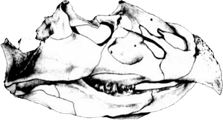
Magnirostris was initially prepared and labelled as a specimen of Protocerarops at the Institute of Vertebrate Paleontology and Paleoanthropology (IVPP) of the Chinese Academy of Sciences in Beijing after its discovery in the Bayan Mandahu area of Inner Mongolia in 1988. Then You Hai-Lu and Dong Zhi-Ming reviewed its remains in 2003 and deduced that it was a different type of critter, based on its big snout and nubbins of brow horns, which they described as most closely related to Bagaceratops that lived in the same area. However, no one realised how close the two were until a study of the variation present within specimens of the latter in 2019 by Czepinski, who concluded that Magnirostris was most likely a growth stage of Bagaceratops and its "unique" features were the result of distortion due to compressive forces during fossilisation.
(Dodson's big snout)Etymology
Magnirostris is derived from the Latin "magnus" (big) and "rostrum" (beak).
The species epithet, dodsoni, honors American paleontologist Peter Dodson.
Discovery
The remains of Magnirostris were discovered at Bayan Mandahu, Inner Mongolia, China, by the Sino-Canadian Dinosaur Project in 1988.The holotype (IVPP V 12513) is an almost complete skull.


