
PACHYRHINOSAURUS
a plant-eating centrosaurine ceratopsid dinosaur from the Late Cretaceous of Canada.
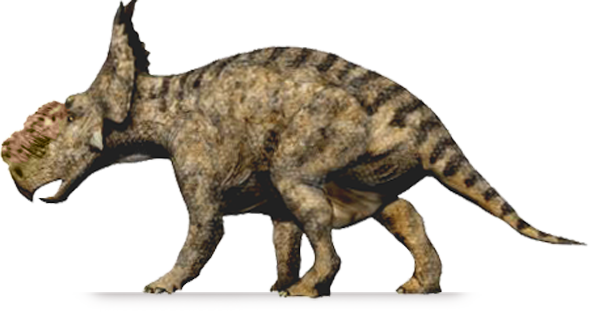
Pronunciation: pak-ee-RI-no-SOR-us
Meaning: Thick-nosed lizard
Author/s: C.M. Sternberg (
1950)
Synonyms: None known
First Discovery: Alberta, Canada
Acta Ordinal: #193
Pachyrhinosaurus canadensis
Herding Behaviour and Bone Beds
Pachyrhinosaurus is one of the strongest cases for gregarious, herd?structured behaviour among ceratopsians. The Horseshoe Canyon Formation preserves large bonebeds containing hundreds of individuals of all ages, interpreted as mass?mortality events. These accumulations suggest large social groups, possibly migratory herds. Catastrophic death causes remain uncertain, though environmental stress or sudden events, such as flooding, severe storms, or drought, are commonly proposed.
Etymology
Pachyrhinosaurus is derived from the Greek "pakhys" (thick), "rhin" (nose) and "sauros" (lizard") because of a thick bony nasal "boss" where most large ceratopsians have a horn. Some researchers think that this boss was merely a platform to support a huge boneless horn made of keratine - a naturally occuring protein that is a major component of things like fingernails, hooves, claw and horn coverings, and hair. Unfortunately it doesn't fossilize so evidence is sadly lacking.
The
species epithet,
canadensis, is derived from "Canada" (its place of discovery) and the Latin "ensis" (from).
ZooBank registry:
urn:lsid:zoobank.org:act:D064BEDB-8F00-4600-85D3-D5F653629500.
Discovery
The first
Pachyrhinosaurus fossils were discovered at Little Bow River in the St. Mary River Formation, Alberta, Canada, by Charles M. Sternberg in 1946.
The
holotype (NMC 8867) is a skull.
Remains of
Pachyrhinosaurus canadensis have also been discovered at the unfortunately named Scabby Butte locality of Alberta's lower Horseshoe Canyon Formation. And a particularly handsome skull (NMC 9485) was found by Wann Langston in 1967 at Munson Ferry near Drumheller.
Estimations
Timeline:
Era: Mesozoic
Epoch: Late Cretaceous
Stage: Campanian-Maastrichtian
Age range: 80-68.5 mya
Stats:
Est. max. length: 8 meters
Est. max. hip height: ?
Est. max. weight: 3 tons
Diet: Herbivore
Pachyrhinosaurus
canadensis
Other Species
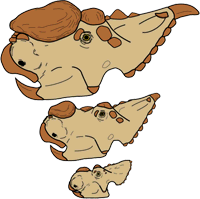 Pachyrhinosaurus perotorum
 (DMNH21200, a partial skull), long known simply as "the Perot Dinosaur", was recovered from Kikak-Tegoseak Quarry in Alaska's Prince Creek Formation (70-68.5 mya) in 2006, and is the northernmost ceratopsid known. As in
Pachyrhinosaurus canadensis, the bosses over its nose and eyes nearly grew together, separated only by a narrow groove, but its "forehead" lacked the two small, hook-like horns. It was named in 2011, and a juvenile specimen was discovered just over a year after that, loitering in blocks that had been removed from the same quarry at the same time, which allowed palaeontologists to plot the growth pattern of its facial lumps. The epithet,
perotorum, is named for Margot and Ross Perot and their children.
Pachyrhinosaurus lakustai (TMP 1986.55.258) is named for Al Lakusta who discovered its first remains along Pipestone Creek, (Wapiti Formation), Alberta, in 1972. When workers from the Royal Tyrrell Museum finally excavated the site between 1986-1989, they discovered thousands of bones and 14 skulls from juvenile to geriatric specimens. Unlike
Pachyrhinosaurus canadensis and
Pachyrhinosaurus perotorum, whose brow and snout bosses virtually merge into one, those of
Pachyrhinosaurus lakustai are separated by a wide gap. Some specimens sport two small frill horns present in
Pachyrhinosaurus canadensis, though some don't, which suggests their presence depended on age or gender.
Pachyrhinosaurus lakustai is the oldest species of
Pachyrhinosaurus (84 to 71 Mya) so could well be the direct ancestor of the other two.
References
• Sternberg CM (1947) "New dinosaur from southern Alberta, representing a new family of the Ceratopsia".
Geological Society America Bulletin, 58: 1230. DOI: 10.1130/0016-7606(1947)58[1161:AOPPAT]2.0.CO;2
• Sternberg CM (1950) "
Pachyrhinosaurus canadensis, representing a new family of the Ceratopsia, from southern Alberta".
National Museum of Canada Bulletin, 118: 109–120.
• Langston W (1967) "The thick-headed ceratopsian dinosaur
Pachyrhinosaurus (Reptilia: Ornithischia), from the Edmonton Formation near Drumheller, Canada".
Canadian Journal of Earth Sciences, 4: 171-186.
• Dodson P (1996) "
The Horned Dinosaurs: a Natural History".
• Lehman TM (2001) "Late Cretaceous dinosaur provinciality". Page 310-328 in Tanke and Carpenter (eds.) "
Mesozoic Vertebrate Life".
• Weishampel DB, Dodson P and Osmolska H (2004) "
The Dinosauria: Second Edition".
• Currie PJ, Langston W and Tanke DH (2008) "A new species of
Pachyrhinosaurus from the Upper Cretaceous of Alberta, Canada". Page 1-108 in Currie, Langston and Tanke (eds.) "
A New Horned Dinosaur from an Upper Cretaceous Bone Bed in Alberta".
Canadian Science Publishing (NRC Research Press).
• Koppelhus EB (2008) "Palynology of the Wapiti Formation in the northwestern part of Alberta with special emphasis on a new Pachyrhinosaur bonebed".
International Dinosaur Symposium in Fukui 2008: Recent Progress of the Study on Asian Dinosaurs and Paleoenvironments. Fukui Prefectural Dinosaur Museum, Fukui: 65-66.
• Erickson GM and Druckenmiller PS (2011) "Longevity and growth rate estimates for a polar dinosaur: a
Pachyrhinosaurus (Dinosauria: Neoceratopsia) specimen from the North Slope of Alaska showing a complete developmental record".
Historical Biology, 23(4): 327-334. DOI: 10.1080/08912963.2010.546856.
• Fiorillo AR and Tykoski RS (2012) "
A new Maastrichtian species of the centrosaurine ceratopsid Pachyrhinosaurus from the North Slope of Alaska" [initially titled "A new species of the centrosaurine ceratopsid
Pachyrhinosaurus from the North Slope (Prince Creek Formation: Maastrichtian) of Alaska" in 2011].
Acta Palaeontologica Polonica, 57(3): 561–573. DOI: 10.4202/app.2011.0033.
• Fiorillo AR and Tykoski RS (2013) "An Immature
Pachyrhinosaurus perotorum (Dinosauria: Ceratopsidae) Nasal Reveals Unexpected Complexity of Craniofacial Ontogeny and Integument in
Pachyrhinosaurus".
PLoS ONE, 8(6): e65802. DOI: 10.1371/journal.pone.0065802.
• Paul GS (2016) "
The Princeton Field Guide to Dinosaurs: Second Edition".
• Tykoski RS, Fiorillo AR and Chiba K (2019) "New data and diagnosis for the Arctic ceratopsid dinosaur
Pachyrhinosaurus perotorum".
Journal of Systematic Palaeontology, 17(16): 1-20.
DOI: 10.1080/14772019.2018.1532464.
• Fiorillo AR and Tykoski RS (2022) "Paleobiological inferences from paleopathological occurrences in the Arctic ceratopsian
Pachyrhinosaurus perotorum".
The Anatomical Record (advance online publication).
DOI: 10.1002/ar.25104.
Time stands still for no man, and research is ongoing. If you spot an error, or want to expand, edit or add a dinosaur, please use
this form. Go
here to contribute to our FAQ.
All dinos are GM free, and no herbivores were eaten during site construction!
To cite this page:
Atkinson, L.
"
PACHYRHINOSAURUS :: from DinoChecker's dinosaur archive".
‹
http://www.dinochecker.com/dinosaurs/PACHYRHINOSAURUS›. Web access: 24th Oct 2026.









