




Pronunciation: AH-kee-or-NITH-o-MIEM-us
Meaning: Ancient bird mimic
Author/s: Russell (1972)
Synonyms: Ornithomimus asiaticus
First Discovery: Nei Mongol, China
Acta Ordinal: #231
Archaeornithomimus asiaticus
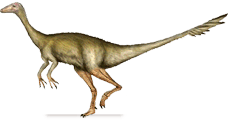
Archaeornithomimus was initially assigned to Ornithomimus as Ornithomimus asiaticus by Charles Whitney Gilmore in 1933, ten years after its discovery by Peter Kaisen, mostly in a Mongolian Quarry that now bears his name. In 1972, Dale Russell coined its current name, meaning "ancient Ornithomimus", because he thought it was the most ancient of the ornithomimids (the flightless "bird mimics"). Unfortunately, Kaisen Quarry was grossly misdated, and this critter isn't nearly as old as once presumed.
Around 3.5 meters long and maybe 80kg in weight, Archaeornithomimus had rather robust hind legs, and contrary to initial reports, it does sport an arctometatarsus, as found in all of its relatives barring Garudimimus and Harpymimus. Also present in troodontids, tyrannosauroids and caenagnathids in varying degrees of severity, the arctometatarsalian design — whereby the middle of three metatarsals (the bones that join the toes to the ankle) is "pinched" by the flanking two — is generally regarded as an adaptation for swift running, but ornithomimids, colloquially known as Ostrich dinosaurs, were probably the swift-runniest dinosaurs of them all.
Around 3.5 meters long and maybe 80kg in weight, Archaeornithomimus had rather robust hind legs, and contrary to initial reports, it does sport an arctometatarsus, as found in all of its relatives barring Garudimimus and Harpymimus. Also present in troodontids, tyrannosauroids and caenagnathids in varying degrees of severity, the arctometatarsalian design — whereby the middle of three metatarsals (the bones that join the toes to the ankle) is "pinched" by the flanking two — is generally regarded as an adaptation for swift running, but ornithomimids, colloquially known as Ostrich dinosaurs, were probably the swift-runniest dinosaurs of them all.
(Ancient Bird Mimic of Asia)Etymology
Archaeornithomimus is derived from the Greek "arkhaios" (ancient), "Ornith" (bird) and "mimos" (mimic). Specifically, it means Ancient Ornithomimus. The species epithet, asiaticus, refers to its discovery in Asia.
Discovery
The remains of Archaeornithomimus were discovered at Kaisen Quarry in the Iren Dabasu Formation, Nei Mongol (Inner Mongolia), Peoples Republic of China, by Peter Kaisen during a Roy Chapman Andrews-led American Museum of Natural History expedition in 1923.
A holotype was never chosen, so David Smith and Peter Galton nominated a foot (AMNH 6565) as lectotype in 1990.


