



Pronunciation: RAB-doh-don
Meaning: Fluted Tooth
Author/s: Matheron (1869)
Synonyms: See below
First Discovery: Bouches-du-Rhône, France
Acta Ordinal: #32
Rhabdodon priscus
The first remains of Rhabdodon priscus—named by Philippe Matheron in 1869—were fragmentary and French. More sketchy French fossils were assigned here over the coming years, but the best booty that it would temporarily lay claim to was found in Hateg, Romania, and was initially split between Mochlodon suessi, coined by Seeley in 1881 for Austrian scraps that Bunzel had named Iguanodon suessi 1871, and the larger, raised-for-the-occasion Mocholodon robustum by Baron Franz Nopcsa in 1900.
By 1902, the Baron was mulling the possibility that all of these specimens represented the same kind of critter, and suspected that their anatomical twists, mainly size-related, were evidence of sexual dimorphism; the differences in appearance between males and females of the same species. Nevertheless, in 1915 he opted to split the remains again while conceding to Matheron's claim of priority, name-wise, but after announcing that Moch. robustum was indistinguishable from Rhabdodon priscus and Moch. suessi should be known as Rhabdodon suessi the pair faded into obscurity and received little more than a passing mention until the 1990s when European dinosaurs became trendy again.
Although back in vogue, many palaeontologists still referred to Rhabdodon as Mochlodon, simply because they thought Rhabdodon was a snake — Rhabdodon fuscus — which physician F.L. Fleischmann coined in his thesis way back in 1831, though, as it turns out, it had never received an official description, had been sunk into synonomy... twice, and its remains were lost. An irate Winand Brinkmann pleaded with the ICZN to flex their muscles and show the dinosaur some love, and they duly obliged in 1988. Then all was quiet for the next five years, until David Weishampel moved the Romanian bits to two species of Zalmoxes!
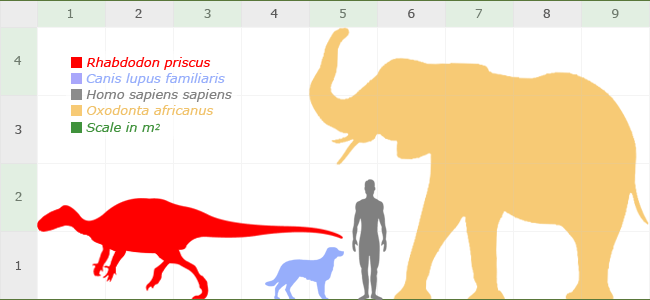
Since the Romanian cull, Rhabdodon has inherited fossils from Spain and France, and possibly owns some from the Czech Republic too, but it remains somewhat obscure. Its fluted, name-prompting teeth, long tail, short neck, beaked mouth, and stocky body have been assigned to Kalodontidae (Nopcsa 1901), Hypsilophodontidae and Dryosauridae (Weishampel, Norman, and Milner 1984), Iguanodontia (Sereno (1986) and Iguanodontidae (Carroll 1988), and have been labelled a "missing link" between Iguanodontia and Hypsilophodontidae. Latest research has it pegged it as a member of Rhabdodontidae, the family that it anchors, which, like all Trannsylvanian dinosaurs, have been called "Island dwarfs" because of their modest size. However, at over four meters in length, Rhabdodon is actually a giant amongst rhabdodontids, and it may be more closely related to a run-of-the-mill iguanodontid called Tenontosaurus.
By 1902, the Baron was mulling the possibility that all of these specimens represented the same kind of critter, and suspected that their anatomical twists, mainly size-related, were evidence of sexual dimorphism; the differences in appearance between males and females of the same species. Nevertheless, in 1915 he opted to split the remains again while conceding to Matheron's claim of priority, name-wise, but after announcing that Moch. robustum was indistinguishable from Rhabdodon priscus and Moch. suessi should be known as Rhabdodon suessi the pair faded into obscurity and received little more than a passing mention until the 1990s when European dinosaurs became trendy again.
Although back in vogue, many palaeontologists still referred to Rhabdodon as Mochlodon, simply because they thought Rhabdodon was a snake — Rhabdodon fuscus — which physician F.L. Fleischmann coined in his thesis way back in 1831, though, as it turns out, it had never received an official description, had been sunk into synonomy... twice, and its remains were lost. An irate Winand Brinkmann pleaded with the ICZN to flex their muscles and show the dinosaur some love, and they duly obliged in 1988. Then all was quiet for the next five years, until David Weishampel moved the Romanian bits to two species of Zalmoxes!
Since the Romanian cull, Rhabdodon has inherited fossils from Spain and France, and possibly owns some from the Czech Republic too, but it remains somewhat obscure. Its fluted, name-prompting teeth, long tail, short neck, beaked mouth, and stocky body have been assigned to Kalodontidae (Nopcsa 1901), Hypsilophodontidae and Dryosauridae (Weishampel, Norman, and Milner 1984), Iguanodontia (Sereno (1986) and Iguanodontidae (Carroll 1988), and have been labelled a "missing link" between Iguanodontia and Hypsilophodontidae. Latest research has it pegged it as a member of Rhabdodontidae, the family that it anchors, which, like all Trannsylvanian dinosaurs, have been called "Island dwarfs" because of their modest size. However, at over four meters in length, Rhabdodon is actually a giant amongst rhabdodontids, and it may be more closely related to a run-of-the-mill iguanodontid called Tenontosaurus.
(Ancient fluted tooth)Etymology
Rhabdodon is derived from the Greek "rhabdosis" (the vertical fluting on a column) and "odon" (tooth), named for the grooves on its teeth.
The species epithet, priscus, means "ancient" in Latin. (Rhabdodon priscus was misspelled Rabdodon priscum on at least one occasion by Matheron during 1869... the same year he named it!)
Oligosaurus adelus (Seeley, 1881)Ornithomerus gracilis (Seeley, 1881)
Both were discovered in the Grünbach Formation, Muthmannsdorf, Austria, and both were named by Harry Govier Seeley in 1881.
Discovery
The first fossils of Rhabdodon were discovered at "Tunnel de la Nerthe" on the Avignon-Marseille railroad line between Marignane and L'Estaque, Fuveau Commune in Bouches-du-Rhône, Provence-Alpes-Côte d'Azur, southern France, by Philippe Matheron in the 1840s.
The name-bearing specimen (a partial lower jaw, catalogued as MPLM 30), deteriorated badly since its discovery, and was nowhere to be found in the MPLM (Palais Longchamp Museum) collections during a visit to Marseille by Czepinski and Madzia in 2023.
Referred material includes MPLM 31 (a partial lower jaw), MPLM 32 (a lower jaw fragment), MPLM 34 (a back vertebra), MPLM 36 (two fused hip vertebrae), MPLM 51 (a left lower arm bone), MPLM 59 and MPLM 61 (both ends of a right thigh), MPLM 60 (part of a right shin), and two tail vertebrae (no collection number given).