









Pronunciation: JU-ra-VEN-uh-tuh
Meaning: Jura hunter
Author/s: Gohlich and Chiappe (2006)
Synonyms: None known
First Discovery: Eichstatt, Germany
Acta Ordinal: #600
Juravenator starki
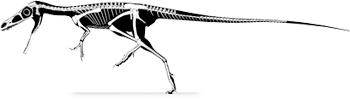
Juravenator is known from a beautifully preserved, almost complete little skeleton found in the same fine-grained limestone as Compsognathus and Archaeopteryx, and was referred to Compsognathidae via some oft-thought questionable techniques. Apparently, Luis Chiappe not-so-much pruned the theropod family tree as decimated it during cladistic analysis which, for all intents and purposes, pounded Juravenator into a group to which it seemingly didn't belong. Several experts have run a half-dozen analyses of their own since then, and Juravenator is not quite what it used to be. Not quite.
Flying in the face of Sinosauropteryx and other compsognathids who are proven to be at least partially feathered, exceptionally preserved patches of skin from the tail base and hind legs of Juravenator clearly sport scales. Unfortunately, before an official paper was released, Juravenator was nick-named "Borsti", which is typically reserved for bristle-haired dogs, and this enraged anti-evolutionists who won't entertain the notion that birds are dinosaurs and the universe could conceivably be older than a few thousand years.
Faced with such ideological resistance, palaeontologists were compelled to study Juravenator more closely and discovered a couple of interesting facts: under UV light its upper tail and hips look to be surrounded with faint impressions of filamentous structures, aka "proto" feathers, and Juravenator isn't a compsognathid at all, it's a primitive coelurosaur, closely related to compsognathids.
Currently, the only known specimen of Juravenator is considered a juvenile because of "sutures"—expansion joints in young bones that fuse together upon adulthood—so it's anyone's guess what size maturity would bring.
Flying in the face of Sinosauropteryx and other compsognathids who are proven to be at least partially feathered, exceptionally preserved patches of skin from the tail base and hind legs of Juravenator clearly sport scales. Unfortunately, before an official paper was released, Juravenator was nick-named "Borsti", which is typically reserved for bristle-haired dogs, and this enraged anti-evolutionists who won't entertain the notion that birds are dinosaurs and the universe could conceivably be older than a few thousand years.
Faced with such ideological resistance, palaeontologists were compelled to study Juravenator more closely and discovered a couple of interesting facts: under UV light its upper tail and hips look to be surrounded with faint impressions of filamentous structures, aka "proto" feathers, and Juravenator isn't a compsognathid at all, it's a primitive coelurosaur, closely related to compsognathids.
Currently, the only known specimen of Juravenator is considered a juvenile because of "sutures"—expansion joints in young bones that fuse together upon adulthood—so it's anyone's guess what size maturity would bring.
Etymology
Juravenator is derived from "Jura" (for the Jura mountains, on the border of France and Switzerland) and the Latin "venator" (hunter). The species epithet, starki, honours the Stark family, who own the chalk quarry in which >Juravenator was found.
In 1799, Alexander von Humbolt described massive limestone formations of the forested Jura Mountain range as the Calcaire de Jura, or Jura-Kalkstein ("Jura Limestone"). Thirty years later, French naturalist Alexandre Brongniart used "terrains jurassiques" when correlating the "Jura-Kalkstein" with similarly aged oolitic limestones in Britain, and in doing so became the first person to use the term "Jurassic", albeit the French version of it.
Discovery
The remains of Juravenator were discovered at "Stark Quarry" in the Painten Formation, just west of Schamhaupten village, Eichstätt district, Southern Franconian Alb, Bavaria, Germany, in summer 1998, by Klaus-Dieter Weiß and his brother Hans-Joachim, during an expedition organised by the Jura-Museum Eichstätt. The holotype (JME Sch 200) is an almost complete and articulated juvenile skeleton (60cm in length) missing the last third of its tail.
Preparators
Pino Völkl of the the Jura-Museum Eichstätt.


