




Pronunciation: fur-GAH-nah-SOR-us
Meaning: Fergana Valley lizard
Author/s: Alifanov and Averianov (2003)
Synonyms: None known
First Discovery: Jalalabad, Kyrgyzstan
Acta Ordinal: #527
Ferganasaurus verzilini
The fossils that would become Ferganasaurus verzilini represented the first sauropod skeleton found in the USSR, but it was afforded just a 2-page preliminary report in 1968 by Anatoly Rozhdestvensky, who assigned its fossils to "Cetiosauridae" and opined that they should probably be referred to a new genus or species.
He refrained from doing so at that point, and his follow-up mention of "Ferganasaurus" in a popular book the next year—where he hyped the skeleton as a "scientific standard, necessary for the study of known and future sauropod finds"—didn’t qualify as a formal nomenclatural act, despite his enthusiasm.
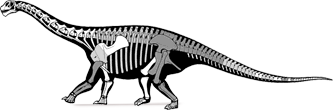
Only in 2003 was Ferganasaurus officially named and described by fellow Russian palaeontologists Alifanov and Averianov, and by that point much of its skeleton had gone missing, which is astounding, given their enormous size. Fortunately, ink drawings of some of the bones had been produced by the Moscow Paleontological Institute not long after excavation, presumably for a Rozhdestvensky monograph that never materialized, and they were studied in lieu of the missing bits.
Despite the fragmentary state of the surviving material, the bones and drawings together reveal an animal with a telling mix of traits. On the one side, much of the skeleton fits comfortably within the neosauropod template: the back and tail vertebrae show the expected joint shapes and supporting ridges; the sacrum and hip region have the typical fused and streamlined layout; and the limb bones—from the shin and calf down to the ankle—carry the proportions and surface features expected of the group. Against that backdrop, two features stand out as old-fashioned—the gently S-curved thighs and the long, pointed, blade-like thigh-ridge known as the fourth trochanter—a large anchor point for the caudofemoralis longus, the powerful tail-based muscle that pulled the thigh backward during each step—that would diminish in later neosauropods.
Despite the fragmentary state of the surviving material, the bones and drawings together reveal an animal with a telling mix of traits. On the one side, much of the skeleton fits comfortably within the neosauropod template: the back and tail vertebrae show the expected joint shapes and supporting ridges; the sacrum and hip region have the typical fused and streamlined layout; and the limb bones—from the shin and calf down to the ankle—carry the proportions and surface features expected of the group. Against that backdrop, two features stand out as old-fashioned—the gently S-curved thighs and the long, pointed, blade-like thigh-ridge known as the fourth trochanter—a large anchor point for the caudofemoralis longus, the powerful tail-based muscle that pulled the thigh backward during each step—that would diminish in later neosauropods.
(Verzilin's Fergana Lizard)Etymology
Ferganasaurus is derived from "Fergana" (for Fergana Valley, where it was found) and the Greek "saurus" (lizard).
The species epithet, verzilini, honours Professor Nikita N. Verzilin, who led the expedition that found the holotype.
Discovery
The remains of Ferganasaurus were discovered in the Balabansai Formation (Balabansai Svita) in the southern foothills of Chatkal
Range, five km
west of Tashkumyr (Tash-Kömür) city in northern Fergana Valley, Jalalabad (Dzhalal-Abad) Province, in the landlocked and mountainous country of Kyrgyzstan (formerly Kirghizia), Central
Asia, by a Professor Nikita N. Verzilin-led geological team of the Leningrad State University in July 1966. They were excavated in August 1966 and July 1967 by a team from the Moscow Paleontological Institute, led by A.K. Rozhdestvensky. The holotype (PIN N 3042/1) is (or rather was) an articulated skeleton, lacking only the skull, neck and some tail vertebrae, both hind feet, and the right hand.
Unfortunately, many of the bones reported as recovered by Rozhdestvensky in 1968 (the back vertebrae, some of the tail vertebrae, the shoulder girdles, and the left hand) are missing from the collections of the Moscow Paleontological Institute where they were housed, and are assumed lost. The left hand is known entirely from a set of ink drawings of some of the bones, apparently prepared for a publication by Rozhdestvensky that never saw the light of day. The complete left thigh and a fragment of the right are on exhibit at Orlov’s Paleontological Museum in Moscow.
In 1967, Verzilin found a second partial sauropod skeleton, including pelvic bones, a partial thigh, and vertebrae from the back, hip and tail, in the middle-upper part of the same Formation that may belong to Ferganasaurus. Unfortunately, the fate of this skeleton is unknown, and it is possible that it was not excavated.


