









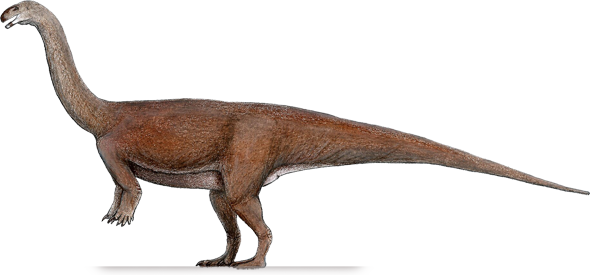
Pronunciation: glay-see-al-eye-sor-us
Meaning: Icy lizard
Author/s: Smith and Pol (2007)
Synonyms: None known
First Discovery: Beardmore, Antarctica
Acta Ordinal: #625
Glacialisaurus hammeri
Tentatively referred to Plateosauridae by Hammer and Hickerson in 1996 based on nothing but size, the remains that would become Glacialisaurus was discovered at a staggering elevation of 4,100 meters on Mount Kirkpatrick in Antarctica, alongside the tooth of a goofy, rodent-like reptile known as a tritylodont, a pterosaur's funny bone, and a theropod whose headcrest resembles Elvis Presley's pompadour hairdo. We're not making this up!
It's christening in 2007 arrived with a rigorous anatomical analysis showing that Glacialisaurus was actually a member of Massospondylidae: a family of robust non-sauropod sauropodomorphs, whose members are more advanced than the likes of Saturnalia and Plateosaurus but more primitive than their much larger and advanced relatives, the sauropods. Furthermore, Glacialisaurus was closely allied with Lufengosaurus from the Lufeng Formation of China which added its weight to the theory that "prosauropods" survived into the Early Jurassic and that they lived, for a short time, alongside the earliest sauropods proper. Then they all starved to death because they couldn't compete with their bigger, hungrier relatives. Probably.
As of 2012, Glacialisaurus (the first Antarctic sauropodomorph), Cryolophosaurus (the first Antarctic theropod), Antarctopelta (the first Antarctic ornithischian), and Trinisaura (the first Antarctic ornithopod), are the only confirmed dinosaurs from Antarctica, but other dinosaurian fossils have been discovered there which have yet to be properly scrutinized.
It's christening in 2007 arrived with a rigorous anatomical analysis showing that Glacialisaurus was actually a member of Massospondylidae: a family of robust non-sauropod sauropodomorphs, whose members are more advanced than the likes of Saturnalia and Plateosaurus but more primitive than their much larger and advanced relatives, the sauropods. Furthermore, Glacialisaurus was closely allied with Lufengosaurus from the Lufeng Formation of China which added its weight to the theory that "prosauropods" survived into the Early Jurassic and that they lived, for a short time, alongside the earliest sauropods proper. Then they all starved to death because they couldn't compete with their bigger, hungrier relatives. Probably.
As of 2012, Glacialisaurus (the first Antarctic sauropodomorph), Cryolophosaurus (the first Antarctic theropod), Antarctopelta (the first Antarctic ornithischian), and Trinisaura (the first Antarctic ornithopod), are the only confirmed dinosaurs from Antarctica, but other dinosaurian fossils have been discovered there which have yet to be properly scrutinized.
(Hammer's Icy/Frozen Lizard)
Etymology
Glacialisaurus is derived from the Latin "glacialis" (icy or frozen) in reference to its place of discovery, and the Greek "sauros" (lizard).
The species epithet, hammeri, honors Dr. William R. Hammer (Augustana College, Rock Island, USA), for his contributions to vertebrate paleontology and Antarctic research.
Discovery
The remains of Glacialisaurus were discovered in the tuffaceous siltstones and mudstones of the lower Hanson Formation, around 4,100 meters up Mount Kirkpatrick (the highest point in the Queen Alexandra Range and the Transantarctic Mountains), Beardmore Glacier region, Antarctica, by a field team from Augustana College led by William Hammer in the austral summer of 1990–1991.
The holotype (FMNH PR1823) consists of bones from the right ankle and foot. A partial right thigh bone (FMNH PR1822) from the same site represents a second individual.


