






Pronunciation: JEN-ee-o-DEK-teez
Meaning: Jaw biter
Author/s: Woodward (1901)
Synonyms: None known
First Discovery: Chubut, Argentina
Acta Ordinal: #85
Genyodectes serus
Missing out on the title by a mere two years, Genyodectes became the second South American dinosaur to be named when Sir Arthur Woodward added it to the roll call of "fearfully great lizards" in 1901. Still, it's the first valid one since Loncosaurus argentinus—an ornithopod, once suspected of being a theropod, that Lessem and Glut haphazardly and erroneously assigned to Genyodectes at one point—was struck off as dubious. And despite its rather fragmentary nature, Genyodectes remained the best-represented non-avian South American dinosaur until the 1970s.
As well as a mysterious provenance, Genyodectes had been referred to as a megalosaurid, a tyrannosaurid, a theropod of uncertain placement, and a possible abelisaurid: perhaps a senior synonym of Abelisaurus itself, by the turn of the 20th century. However, when Oliver Rauhut removed its fossils from their artificial display matrix in 2004, he declared a probable Cerro Barcino origin based on the manner of bone preservation compared to other dinosaurs from various Argentine Formations. Furthermore, he recovered Genyodectes as a close relative of Ceratosaurus because its teeth just don't resemble those of any other theropod dinosaur.
As well as a mysterious provenance, Genyodectes had been referred to as a megalosaurid, a tyrannosaurid, a theropod of uncertain placement, and a possible abelisaurid: perhaps a senior synonym of Abelisaurus itself, by the turn of the 20th century. However, when Oliver Rauhut removed its fossils from their artificial display matrix in 2004, he declared a probable Cerro Barcino origin based on the manner of bone preservation compared to other dinosaurs from various Argentine Formations. Furthermore, he recovered Genyodectes as a close relative of Ceratosaurus because its teeth just don't resemble those of any other theropod dinosaur.
Late-living jaw biterEtymology
Genyodectes is derived from the Greek "genys" (jaw) and "dektes" (biter), named for its relatively large, obviously carnivorous teeth.The species epithet, serus, means "late" in Latin.
Discovery
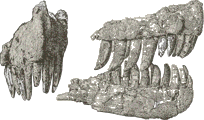
The only known remains of Genyodectes were discovered at Cañadón Grande, Departamento Paso de Indios, Chubut Province, Argentina, probably in the Cerro Castaño Member of the Cerro Barcino (also known as the Gorro Frigio) Formation.The holotype (MLP 26-39) consists of partial upper and lower jaws with teeth.


