









Pronunciation: FOO-ta-LONG-koh-SOR-us
Meaning: Giant chief lizard
Author/s: Calvo et al. (2007)
Synonyms: None known
First Discovery: Neuquén, Argentina
Acta Ordinal: #646
Futalognkosaurus dukei
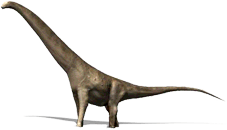
Of all the giant dinosaurs regularly opined to be the biggest ever, Futalognkosaurus is one of the best represented, fossil-wise. Three specimens from Argentina's Neuquén Province have chipped in with almost 70% of a skeleton when combined, which showed that this Late Cretaceous "Chief Lizard" was huge to the tune of 32-34 meters long and as heavy as seven elephants. But it wasn't just big, it was also robust, with hips almost three meters across at their widest point and a long, deep neck, for which lognkosaurs are renowned.
The neck of Futalognkosaurus was extremely deep, thanks to robust sharkfin-shaped spines on the top of the vertebrae that would have anchored huge wads of muscle, but the creature itself wasn't quite as long as initially thought. When Calvo and colleagues coined Lognkosauria to house Futalognkosaurus, along with Mendozasaurus and Puertasaurus (which may be the most colossal dinosaur known from remains that haven't mysteriously disappeared), they miscounted its back vertebrae and thought there were eleven of them, when, in fact, there were only ten.
The neck of Futalognkosaurus was extremely deep, thanks to robust sharkfin-shaped spines on the top of the vertebrae that would have anchored huge wads of muscle, but the creature itself wasn't quite as long as initially thought. When Calvo and colleagues coined Lognkosauria to house Futalognkosaurus, along with Mendozasaurus and Puertasaurus (which may be the most colossal dinosaur known from remains that haven't mysteriously disappeared), they miscounted its back vertebrae and thought there were eleven of them, when, in fact, there were only ten.
(Duke Energy Argentina's Giant Chief Lizard)Etymology
Futalognkosaurus, named by Calvo, Porfiri, Gonzalez-Riga and Kellner in 2007 a full seven years after its discovery, is derived from the Mapuche "Futa" (giant) and "Lognko" (chief), and the Greek "sauros" (lizard).
The species epithet, dukei, honors Duke Energy Argentina, which helped fund the skeleton's excavation.
Discovery
The first remains of Futalognkosaurus were discovered in March 2000 on the northern shore of Lake Barreales in the Portezuelo Formation (Rio Neuquén Subgroup, Neuquén Group), 90 km northwest of Neuquén City, in Argentina's Neuquén Province. With so many "Neuquén"s, a name like Neuquensaurus may seem like a more obvious choice. Unfortunately, J.E. Powell beat the authors to the punch when he assigned that name to a saltasaurid titanosaur in 1992. The holotype (MUCPv-323) includes a complete series of fused hip vertebrae (sacrum), twelve neck (cervical) vertebrae, ten back (dorsal) vertebrae, one tail (caudal) vertebrae, pelvic bones (both ilia, right pubis and ischium) and some ribs, housed at the Museo de Geologia y Paleontologia de la Universidad Nacional del Comahue, Neuquén, Argentina.


