









Pronunciation: GAL-ih-MY-mus
Meaning: Chicken mimic
Author/s: Osmólska et al. (1972)
Synonyms: None known
First Discovery: Gobi Desert, Mongolia
Acta Ordinal: #233
Gallimimus bullatus
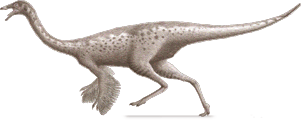
With an un-trained eye it's hard to see what possesed Osmólska, Roniewics and Barsbold to think that Gallimimus resembled a chicken.
It was six meters long and as heavy as a horse! But scrutiny of its neck vertebrae reveals similarities to those of Galliformes—the fowl family that includes chickens—and in keeping with the trend of naming ornithomimosaurs after living or mythgical birds (Harpymimus—Harpy mimic, Pelecanimimus—Pelican mimic, Anserimimus—Goose mimic, and so on), Gallimimus duly became the "chicken mimic".
Although dwarfed by the outlandish Deinocheirus, Gallimimus was the largest of the new-fangled advanced ornithomimosaurids but had the shortest three-fingered hands relative to arm length. The snout—entirely toothless and capped with a horny beak—was longer than in most of its kin, and the neck was flexible and proportionally long compared to the trunk. Large side-mounted eyes limited binocular overlap, which doesn't hamper modern ratites with a similar set-up, while long and powerful legs enabled it to shift like a roadrunner, which, sadly, remains one of the birds not yet mimicked in the swift-footed "bird mimic" naming conventions. You know Geococcimimus makes sense.
Ornithomimosaurs in general were likely feathered, had relatively small heads, and were the first of the theropod branch to evolve away from a purely carnivorous diet to enjoy a varied spread of lizards and insects with greens, and maybe the odd egg. Once upon a time, there was a theory that ridges on the long snout of Gallimimus may have anchored a duck-like filter feeding attachment so it could supplement its diet with sieved pondlife, but such a feature would've been a little redundant in its rather arid habitat.
Although dwarfed by the outlandish Deinocheirus, Gallimimus was the largest of the new-fangled advanced ornithomimosaurids but had the shortest three-fingered hands relative to arm length. The snout—entirely toothless and capped with a horny beak—was longer than in most of its kin, and the neck was flexible and proportionally long compared to the trunk. Large side-mounted eyes limited binocular overlap, which doesn't hamper modern ratites with a similar set-up, while long and powerful legs enabled it to shift like a roadrunner, which, sadly, remains one of the birds not yet mimicked in the swift-footed "bird mimic" naming conventions. You know Geococcimimus makes sense.
Ornithomimosaurs in general were likely feathered, had relatively small heads, and were the first of the theropod branch to evolve away from a purely carnivorous diet to enjoy a varied spread of lizards and insects with greens, and maybe the odd egg. Once upon a time, there was a theory that ridges on the long snout of Gallimimus may have anchored a duck-like filter feeding attachment so it could supplement its diet with sieved pondlife, but such a feature would've been a little redundant in its rather arid habitat.
Etymology
Gallimimus is derived from the Latin "gallus" (chicken) and "mimos" (to mimic), referring to the front part of its neck vertebrae being strikingly similar to those of the Galliformes (ground-dwelling, mostly delicious, birds such as chickens, turkeys, quaill and the like).
The species epithet, bullatus, is derived from the Latin "bulla" (hollow swelling) and "atus" (provided with), referring to the unusual capsule (known to boffins as "bulbous parasphenoid capsule") at the base of the skull. According to the authors, the name is specifically a reference to a golden capsule (bulla) that young boys of noble Roman families wore around their neck.
Discovery
The first remains of Gallimimus were recovered from four different localities (Nemegt, Tsagan Khushu, Altan Ula IV and Naran Bulak) of the Nemegt Formation in Mongolia's
Omnogovi aimag (south gobi province) during the Polish-Mongolian Palaeontological Expeditions between 1963 and 1965. The holotype (IGM 100/11, initially catalogued as G.I.No.DPS 100/11), found by Zofia Kielan-Jaworowska at the Tsagan Khushu site in 1964, is the largest specimen and consists of a partial skeleton including the skull and lower jaws.
Referred specimens include ZPAL MgD-I/1 (a small fragmentary skeleton with skull that was also found in Tsaagan Khushuu the same year as the holotype), ZPAL MgD-I/94 (another small specimen, lacking the skull, from the Nemegt locality), and twenty-one fragmentary specimens, nine of which were represented by single bones. The smallest, relatively complete specimen (IGM 100/10) was found in 1967 by a Mongolian palaeontological expedition to Bugeen Tsav.
Tarbosaurus bataar, Saurolophus angustirostris and Dyoplosaurus giganteus are also known from the same formation.
Preparator
Joanna Skarzynska of the Palaeozoological Institute, Polish Academy of Sciences, Warsaw.


