









Pronunciation: al-BUHR-ta-SEH-ruh-tops
Meaning: Alberta horn face
Author/s: Ryan (2007)
Synonyms: Nothing official
First Discovery: Alberta, Canada
Acta Ordinal: #636
Albertaceratops nesmoi
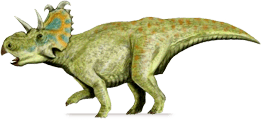
Discovered on the Pinhorn Grazing Reserve in Alberta's Milk River badlands in August 2001, Albertaceratops blew palaeontologists' minds with its huge chasmosaurine-like brow horns attached to an otherwise typical centrosaurine skull. And with one look at the two large, thick hooks snaking forward from the apex of its frill, Dr Michael Ryan immediately decided to name it "Medusaceratops" after the Greek hell hag with serpents for hair and a gaze that could turn mortals to stone. The crowd went wild.
Alas, this was only Ryan's dissertation, and he changed his mind before releasing an official description, instead settling on the inconceivably mundane Alberataceratops in 2007, even though it wasn't exclusively from Alberta. Ryan added two twice-misidentified skull frills from Montana's Mansfield Bonebed to his Alberatceratops bone pile, which caused him (and others before him) many sleepless nights. So he removed them, eventually, and officially unveiled a Medusaceratops in 2010.
Albertaceratops is amongst the most primitive of the centrosaurines and resides on the dinosaurian family tree just above the spot where they branched away from the chasmosaurines: the horned dinosaurs that were known as ceratopsines until Ceratops was deemed an unfit name-bearer. It is also the first known centrosaurine to have a nose horn that isn't the biggest horn on its face, because its nose "horn" amounts to a long, shallow, banana-shaped protrusion where an impressive centrosaurine nose horn would usually be.
Alas, this was only Ryan's dissertation, and he changed his mind before releasing an official description, instead settling on the inconceivably mundane Alberataceratops in 2007, even though it wasn't exclusively from Alberta. Ryan added two twice-misidentified skull frills from Montana's Mansfield Bonebed to his Alberatceratops bone pile, which caused him (and others before him) many sleepless nights. So he removed them, eventually, and officially unveiled a Medusaceratops in 2010.
Albertaceratops is amongst the most primitive of the centrosaurines and resides on the dinosaurian family tree just above the spot where they branched away from the chasmosaurines: the horned dinosaurs that were known as ceratopsines until Ceratops was deemed an unfit name-bearer. It is also the first known centrosaurine to have a nose horn that isn't the biggest horn on its face, because its nose "horn" amounts to a long, shallow, banana-shaped protrusion where an impressive centrosaurine nose horn would usually be.
(Nesmo's Alberta Horn Face)Etymology
Albertaceratops is derived from "Alberta" (its place of discovery, which is itself named after Princess Louise Caroline Alberta [1848-1939], the fourth daughter of Queen Victoria and Prince Albert), and the Greek "ceras" (horn) and "ops" (face). The species epithet, nesmoi, honours local rancher Cecil Nesmo, who assisted with the collection of this any many more specimens from the Manyberries area.
Discovery
The remains of Albertaceratops were discovered in the lower Oldman Formation, Milk River badlands, south side
of Milk River on the Pinhorn Grazing Reserve, approximately 15 km south of Manyberries, Alberta, Canada, in August of 2001. The holotype (TMP 2001.26.1.) is an almost complete skull.
Initially, two skull frills from Montana that had already been linked to Styracosaurus albertensis (Sweeney and Boyden, 1992) and Ceratops montanus (Trexler and Sweeney, 1995) were assigned here, but they were officially named Medusaceratops in 2010.


