









Pronunciation: SALT-oh-puss
Meaning: Hopping foot
Author/s: Friedrich von Huene (1910)
Synonyms: None known
First Discovery: Lossiemouth, Scotland
Acta Ordinal: #98
Saltopus elginensis
McSaltopus was once thought to be Scotland's first and only contribution to the dinosaurian fossil record. It was once thought to be the oldest dinosaur too, and upon discovery, German palaeontologist Friedrich von Huene reckoned its hind limbs resembled those of a frog. According to his 1910 notes, the legs of Saltopus were too long and misproportioned to allow an upright posture, never mind elevated transit, and locomotion would be limited to creeping and hopping, hence the name, which means "hopping foot".
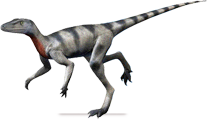
Saltopus was probably about the size of a domestic cat, with hollow bones, five-fingered hands, and a tail that accounted for 50% of its modest body length. The problem is that it's known mostly from spine, hip, tail and limb imprints of where bones used to be (a negative fossil, if you like), with just the faintest whiff of actual physical remains, so any estimations are, well, guestimations. From the lay of its bones, it seems to have died lying belly down.
Because Saltopus remains are so miserably poor, its taxonomy (the science of grouping organisms) has been nothing but problematic and provoked feelings of fear, anxiety and irritation, even in seasoned science veterans. At various times, palaeontologists have classed it as a saurischian, a juvenile theropod, a herrerasaurid, a lagosuchid and an ornithosuchian. Unfortunately for Scotland, it may be a dinosauriforme: not a member of Dinosauria, but one of the dinosaur's closest non-dinosaurian relatives. It's lucky to have a web page.
Saltopus was probably about the size of a domestic cat, with hollow bones, five-fingered hands, and a tail that accounted for 50% of its modest body length. The problem is that it's known mostly from spine, hip, tail and limb imprints of where bones used to be (a negative fossil, if you like), with just the faintest whiff of actual physical remains, so any estimations are, well, guestimations. From the lay of its bones, it seems to have died lying belly down.
Because Saltopus remains are so miserably poor, its taxonomy (the science of grouping organisms) has been nothing but problematic and provoked feelings of fear, anxiety and irritation, even in seasoned science veterans. At various times, palaeontologists have classed it as a saurischian, a juvenile theropod, a herrerasaurid, a lagosuchid and an ornithosuchian. Unfortunately for Scotland, it may be a dinosauriforme: not a member of Dinosauria, but one of the dinosaur's closest non-dinosaurian relatives. It's lucky to have a web page.
(Elgin's Hopping Foot)Etymology
Saltopus is derived from the Latin "salto" (spring or hop) and the Greek "pous" (foot). The species epithet, elginensis, combines "Elgin" (a city close to the discovery site that is steeped in ancient history) with the Latin "ensis" (from).
Discovery
The remains of Saltopus were discovered in the Lossiemouth Sandstone Formation in the Lossiemouth West & East Quarries, Elgin, Moray (Morayshire), Scotland, by William Taylor.
The holotype (BMNH R3915) consists of the ropiest of partial skeletons.


