




dinochecker
Welcome to our NOMINGIA entry...
Archived dinosaurs: 1221
fb twit g+ feed
Dinosaurs from A to Z
Click a letter to view...
A B C D E F G
H I J K L M N
O P Q R S T U
V W X Y Z ?

NOMINGIA

an omnivorous oviraptorid theropod dinosaur from the Late Cretaceous of Mongolia.
nomingia
Pronunciation: no-MIN-gee-uh
Meaning: for Nomingiin
Author/s: Barsbold et al. (2000)
Synonyms: None known
First Discovery: Gobi Desert, Mongolia
Discovery Chart Position: #469

Nomingia gobiensis

The tail of Nomingia consists of just 24 vertebrae meaning that, amongst theropod dinosaurs, only the tail of Caudipteryx, with 22 vertebrae, is shorter. It is also the first known non-bird dinosaur to sport a pygostyle or "parsons nose", formed by the last five tail vertebrae being fused into a single plate. In birds, the pygostyle supports long feathers that provide stability and control during flight. Nomingia, however, is an oviraptorosaur, and they couldn't fly due to (amongst other things) tiny wings and lots of heavy muscle, the most notable being a massive "caudofemoralis"—attached to both thigh and tail—which is a power pack for explosive acceleration.
(for Nomingiin, from the Gobi)Etymology
Nomingia is named for the Nomingiin region of the Gobi Desert. The species epithet, gobiensis (GO-bee-EN-sis), is derived from "Gobi" (for the Gobi Desert) and the Latin "-ensis" (from).
Discovery
The remains of Nomingia were discovered in the Nemegt Formation at Bugeen Tsav (aka Bugin Tsav, Bugiin Tsav), Bayankhongor Province, Gobi Desert, Mongolia, by the Mongolian-Japanese Palaeontological Expedition in 1994.
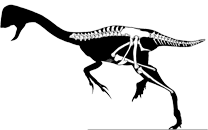
The holotype (GIN 100/119, referred to as GIN 940824 by Barsbold et al. 2000a) is an incomplete skulless skeleton consisting of a series of 13 back, 5 hip and 24 tail vertebrae, 17 tail chevrons, 10 fragmentary ribs, a virtually complete pelvis, a left thigh, and both calfs and shins.
Persons, Currie and Norell referred a second pygostyle (MPC-D 102/5), from the Nemegt Formation at Western Sayr, to Nomingia in 2014.
Estimations
Timeline:
Era: Mesozoic
Epoch: Late Cretaceous
Stage: Maastrichtian
Age range: 71-66 mya
Stats:
Est. max. length: 1.7 meters
Est. max. hip height: ?
Est. max. weight: 20 Kg
Diet: Herbivore
References
• Barsbold R, Currie PJ, Myhrvold NP, Osmólska H, Tsogtbaatar K and Watabe M (2000a) "A pygostyle from a non-avian theropod". Nature, 403(6766): 155-156. DOI: 10.1038/35003103.
• Barsbold R, Osmólska H, Watabe M, Currie PJ and Tsogtbaatar K (2000b) "New Oviraptorosaur From Mongolia: The First Dinosaur With A Pygostyle". Acta Palaeontologica Polonica, 45(2): 97-106.
• Osmólska H, Currie PJ and Barsbold R (2004) "Oviraptorosauria". Page 165–183 in Weishampel, Dodson and Osmólska (eds.) "The Dinosauria: Second Edition".
• Paul GS (2010) "The Princeton Field Guide to Dinosaurs".
• Persons WS, Currie PJ and Norell MA (2014) "Oviraptorosaur tail forms and functions". Acta Palaeontologica Polonica, 59(3): 553-567. DOI: 10.4202/app.2012.0093.
• Funston GF, Mendonca SE, Currie PJ, Barsbold R (2018) "Oviraptorosaur anatomy, diversity and ecology in the Nemegt Basin". Palaeogeography Palaeoclimatology Palaeoecology, 494: 101-120. DOI: 10.1016/j.palaeo.2017.10.023.
• Funston GF, Currie PJ, Tsogtbaatar C and Tsogtbaatar K (2021) "A partial oviraptorosaur skeleton suggests low caenagnathid diversity in the Late Cretaceous Nemegt Formation of Mongolia". PLOS ONE, 16(7): e0254564. DOI: 10.1371/journal.pone.0254564.
Email    Facebook    Twitter    Reddit    Pinterest
Time stands still for no man, and research is ongoing. If you spot an error, or want to expand, edit or add a dinosaur, please use this form. Go here to contribute to our FAQ.
All dinos are GM free, and no herbivores were eaten during site construction!
To cite this page:
Atkinson, L. "NOMINGIA :: from DinoChecker's dinosaur archive".
›. Web access: 06th Mar 2026.
  top