





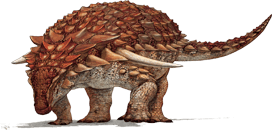
Pronunciation: BOH-ree-AH-low-PEL-tuh
Meaning: Northern shield
Author/s: Caleb Brown, et al. (2017)
Synonyms: None known
First Discovery: Alberta, Canada
Acta Ordinal: #979
Borealopelta markmitchelli
Despite being rustic, stocky-built critters and armoured to the nines, nodosaurid ankylosaurs have seldom given palaeontologists more than a glimpse of their former selves, but that's as much to do with the way they were preserved as it is the when and where. Besides an unfortunate trip or slip into a river that ended its life, all of the stars aligned to immortalise Borealopelta, which floated out to sea full of decompositional gases, exploded, lost its tail and most of its hind limbs, and sank into the soft, pillowy ocean floor that cradled its back. Then a duvet of slurry covered its underside before it could be torn apart by one of the vicious prehistoric sea creatures that the area is notorious for. The speed of its burial was key, as the mineral-rich sediment invaded its soft tissue and preserved everything more or less where it should be. And even the shovel of a monstrous muck digger and an unfortunate mishap during extraction over a hundred million years later couldn't destroy the "mummy" of Borealopelta, which is, quite simply, spectacular.
(Mitchell's northern shield)Etymology
Borealopelta is derived from the Latin "borealis" (northern) and the Greek "pelta" (shield), in reference to the northern locality where it was found and the bony plates, called osteoderms, that are embedded in its skin. The species epithet, markmitchelli, honors Mark Mitchell for his more than 7,000 hours of patient and skilled preparation of the holotype.
ZooBank registry: urn:lsid:zoobank.org:act:A35CC36D-14B3-43CD-915E-D52004E322EA.
Discovery
The remains of Borealopelta were discovered in the Wabiskaw Member of the Clearwater Formation at Suncor Millennium Mine, near Fort McMurray, Alberta, Canada, by heavy-equipment operator Shawn Funk on March 21st, 2011.
The holotype (TMP 2011.033.0001) is an articulated specimen including the head, neck, most of the trunk and sacrum, a complete right and a partial left forelimb and hand, and a partial foot. The upper surface of its skull, neck, back and hips are covered with osteoderms that lie where they would have during life, and scales and soft tissue are preserved on parts of the forelimbs, palms of the hands and soles of the feet.
After its discovery, palaeontologists chipped away surrounding rock from Borealopelta and plaster-wrapped a boulder-sized mass containing its bones, ready for extraction, when disaster struck. As they attempted to lift the jacketed specimen for transport, the plaster case split in two, and the contents broke apart and spilt out like a piñata. When it arrived at the Royal Tyrrell Museum, it took Mark Mitchell a full six years to clean the pieces, identify fragments, and put the skeleton back together.
The exceptionally well-preserved holotype preserves a distinct mass within the stomach area consisting of plant material dominated by 88% leaf tissue (85% leptosporangiate ferns, 3% low cycad-cycadophyte, and trace conifer foliage), including intact sporangia, leaf cross-sections, cuticle and stems, but also wood and charcoal. Scientists suspect the presence of charcoal may represent the dietary use of a recently burned conifer forest undergoing fern succession, as ferns are often the first to emerge following a forest fire.


