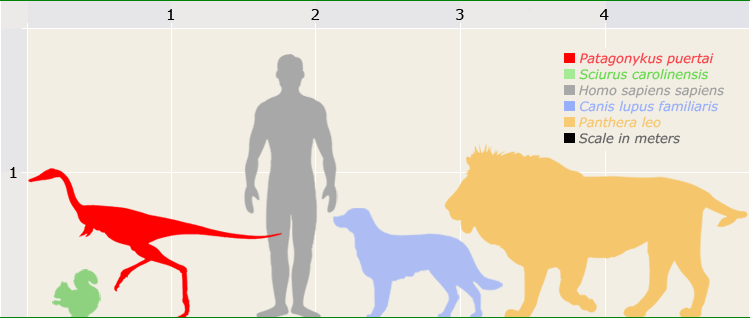
Pronunciation: pat-uh-guh-NYE-kuhs
Meaning: Patagonian claw
Author/s: Novas (1996)
Synonyms: None known
First Discovery: Neuquén, Argentina
Acta Ordinal: #419
Patagonykus puertai
Patagonykus was initially described as a bizarre "basal bird" and plonked alongside Mononykus and Alvarezsaurus in a group known as Alvarezsauridae. While alvarezsaurids do sport many features in common with our avian friends, they're not actually birds but small maniraptoran theropod dinosaurs with highly modified, short yet powerful forelimbs and long hindlimbs.
Patagonykus is basal within Alvarezsauridae, though, anchoring a subfamily of its own (Patagonykinae), and was the largest known alvarezsaurid until the discovery of Bonapartenykus — which, funnily enough, is its closest relative.
Etymology
Patagonykus is derived from "Patagonia" (the region of southern Argentina where it was discovered) and the Latin "onykus" (claw). The name Patagonia itself goes back to the 1520 voyage of Ferdinand Magellan, whose chronicler Antonio Pigafetta described encountering unusually tall Indigenous people in a vivid — and likely exaggerated — account, referring to them as patagón, a term probably borrowed from a giant in the 1512 Spanish chivalric romance Primaleón. Pigafetta’s embellished description helped seed later European myths of "Patagonian giants" which in turn encouraged the later folk reinterpretation of patagón as meaning "big-footed" inhabitants.
The species epithet, puertai, honours Argentine fossil hunter and preparator Pablo Puerta.
Discovery
The remains of Patagonykus were discovered at "Sierra del Portezuelo" in the Portezuelo Formation (formerly known as the Portezuelo member) of the
Rio Neuquén Subgroup (previously known as the Rio Neuquén Formation) of the Neuquén Group, 22 km west of Plaza Huincul, Neuquén Province, Argentina, by a crew of workers from Museo Argentino de Ciencias Naturales "Bernardino "Rivadavia", Museo Paleontológico "Egidio Feruglio" and Museo Municipal "Carmen Funes" in 1990-1991.
The holotype (PVPH 37) is an incomplete but well-preserved skeleton, lacking a skull.