









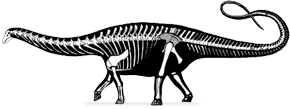
Pronunciation: AM-uh-zon-SOR-us
Meaning: Amazon river lizard
Author/s: Carvalho et al. (2003)
Synonyms: None known
First Discovery: Maranhão, Brazil
Acta Ordinal: #542
Amazonsaurus maranhensis
The Amazon basin covers seven million square km of South America, and five and a half million of that is broad-leafed rainforest. Fortunately, Amazonsaurus was found right on the eastern limits of the Brazilian
Legal Amazon, in a sun-parched old river delta, so Carvalho and colleagues didn't need the gods on their side to help locate it, just shovels and picks, and plenty of water to prevent dehydration in the scorching Brazilian heat.
An obscure sauropod, though probably a diplodocoid judging by the tall neural spines on its tail vertebrae, Amazonsaurus is the first early Cretaceous-aged sauropod known from Brasil and the first named dinosaur from the Amazon basin. But its remains are fragmentary which is making its placement at a more specific family level a bit problematic.
Diplodocoids never made it out of the Early Cretaceous, nor did the diplodocoid-eating carcharodontosaurids. Their sudden disappearance in the fossil record has led some palaeontologists to speculate that an extinction event literally stopped them dead in their tracks and from this point onwards the herbivorous titanosaurs and predatory abelisaurids were free to diversify and rush into the vacant "huge plant-muncher" and "huge plant-muncher-munching" niches, at least in South America and Africa.
An obscure sauropod, though probably a diplodocoid judging by the tall neural spines on its tail vertebrae, Amazonsaurus is the first early Cretaceous-aged sauropod known from Brasil and the first named dinosaur from the Amazon basin. But its remains are fragmentary which is making its placement at a more specific family level a bit problematic.
Diplodocoids never made it out of the Early Cretaceous, nor did the diplodocoid-eating carcharodontosaurids. Their sudden disappearance in the fossil record has led some palaeontologists to speculate that an extinction event literally stopped them dead in their tracks and from this point onwards the herbivorous titanosaurs and predatory abelisaurids were free to diversify and rush into the vacant "huge plant-muncher" and "huge plant-muncher-munching" niches, at least in South America and Africa.
(Amazon lizard from Maranhão)Etymology
Amazonsaurus is derived from "Amazon" (for the type-locality which is part of the Brazilian Legal Amazon region) and the Greek "sauros" (lizard).The species epithet, maranhensis, is derived from "Maranhão" (the Brazilian state in which it was found) and the Latin "ensis" (from).
Discovery
The remains of Amazonsaurus were discovered at the Mata locality in the Itapecuru Formation, Parnaíba Basin, Itapecuru-Mirim County, Maranhão State, northern Brazil.
The holotype (MN 4555-V, 4556, 4558, 4559, 4560, 4562, 4564; UFRJ-DG 58-R/1, 2, 3, 4, 5, 6, ) is a partial skeleton. As of 2012 these are the only identifiable sauropod remains from the early Cretaceous of Brazil.
Preparators
Mr Vanderlon Messias da Silva, Mr João Ismael da Silva (Centro de Pesquisas Paleontológicas L. I. Price),
Dr Ramsés Capilla (Petrobras).


