




Pronunciation: gra-SILL-ih-SEH-ruh-tops
Meaning: Slender horn face
Author/s: Sereno (2000)
Synonyms: Microceratops
First Discovery: Ömnögovi, Mongolia
Acta Ordinal: #476
Graciliceratops mongoliensis
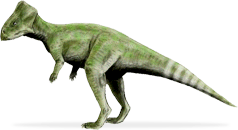
If there was ever such a thing as a graceful ceratopsian — the "horn-faced" herbivores who would eventually evolve into huge, four-legged beasts — Graciliceratops is it. Apart from lacking even the faintest whiff of a horn on its face, the only known specimen of Graciliceratops was 80cm long, around 40cm high, and perhaps weighed 2 kg in life, and all of those proportions are explained by one simple fact: it was a mere juvenile.
Graciliceratops is based on an articulated skeleton from Shiregin Gashun that Maryanska and Osmólska had assigned to Microceratops in 1975, based on nothing more than a similarly modest size. But it was removed and renamed in 2000 by Paul Sereno, who was less than complimentary about the critter it was once assigned to, particularly the state of its meagre and diagnostic feature-dodging fossils.
As with most juvenile specimens, there's a decent chance that Graciliceratops represents an immature form of an adult ceratopsian that is already known to science, but no one has a clue what this adult form could be. All that's known for certain, is that Graciliceratops had a parrot-like beak, its frill was small and slender, and its shins were longer than its thighs, suggesting it could run on its hind legs at a rate of knots.
As dinosaurs aren't mammals, all young were born from eggs, so mamma's milk was not an option, therefore the young Graciliceratops likely fed on the same broad palette of Mesozoic plants as their parents did — ferns, cycads and conifers — though may not have processed food in quite the same way.
Graciliceratops is based on an articulated skeleton from Shiregin Gashun that Maryanska and Osmólska had assigned to Microceratops in 1975, based on nothing more than a similarly modest size. But it was removed and renamed in 2000 by Paul Sereno, who was less than complimentary about the critter it was once assigned to, particularly the state of its meagre and diagnostic feature-dodging fossils.
As with most juvenile specimens, there's a decent chance that Graciliceratops represents an immature form of an adult ceratopsian that is already known to science, but no one has a clue what this adult form could be. All that's known for certain, is that Graciliceratops had a parrot-like beak, its frill was small and slender, and its shins were longer than its thighs, suggesting it could run on its hind legs at a rate of knots.
As dinosaurs aren't mammals, all young were born from eggs, so mamma's milk was not an option, therefore the young Graciliceratops likely fed on the same broad palette of Mesozoic plants as their parents did — ferns, cycads and conifers — though may not have processed food in quite the same way.
(Slender horn face from Mongolia)Etymology
Graciliceratops is derived from the Latin "gracilis" (slender), and the Greek "ceras" (horn) and "ops" (face).The species epithet, mongoliensis (MONG-go-lee-EN-sis), means "from Mongolia" in Latin.
Discovery
The remains of Graciliceratops were discovered in the Shiregin Gashun Formation, Ömnögovi (south Gobi) aimag (province), Mongolia, in 1971.
The holotype (PAL MgD-I/156) is a partial skeleton, lacking the bone fusion that arrives with adulthood, consisting of a fragmentary skull, four neck, twelve back and seven hip vertebrae, a partial shoulder girdle, a right upper arm and partial right forearm, a partial left upper arm, partial left thigh, left shin and fragmentary left foot, a right thigh, right shin and nearly complete right foot, fragments of pelvic bones, and isolated ribs.


