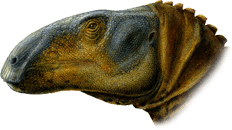
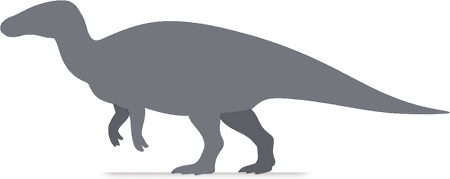
a plant-eating hadrosauroid iguanodont dinosaur from the Early Cretaceous of North America.
Pronunciation: EE-o-LAM-bee-uh
Meaning: Dawn lambeosaurine
Author/s: Kirkland (
1998)
Synonyms: See
below
First Discovery: Utah, USA
Acta Ordinal: #432
Eolambia caroljonesa
(Carol Jones' Dawn Lambeosaurine)Etymology
Eolambia is derived from the Greek "eos" (dawn) and "Lambe" (for Lawrence M. Lambe who described the skulls [found by Charles H. Sternberg] that would become
Lambeosaurus, the anchor of Lambeosaurinae). Funnily enough,
Eolambia is no longer considered a lambeosaurine, but a more primitive hadrosauroid.
The
species epithet,
caroljonesa, honours Carol Jones, who discovered the fossil site.
Eohadrosaurus caroljonesi (Kirkland, 1997—informal useage
in review paper)
Discovery
The first remains of
Eolambia were discovered in the Mussentuchit Member of the Cedar Mountain Formation, Emery County, Utah, USA by Carol Jones and her husband, Ramal Jones, in 1992.
The Quarry, located on the San Rafael Swell Anticline near Castle Dale, was also named in honour of Carol Jones ("Carol Quarry") and is where
Animantarx became the first dinosaur to be discovered by ground scanning technology.
The
holotype (CEUM 9758) is a partial adult skull and skeleton.
Paratypes, from the Mussentuchit Member of the Cedar Mountain Formation, include the partial skull and forelimb of a large adult (CEUM 5212) from CEUM locality 42em369v; a partial juvenile skeleton, including numerous vertebrae, both shoulder blades, a right lower arm, hip bones, thigh fragments, partial shins, and hand and foot bones, from OMNH locality v237; a partial juvenile skeleton with pieces of skull, a back vertebra, arm bones, hand bones, and a right shin, from OMNH locality v824; a partial skeleton (OMNH 27749), including hip bones, from OMNH locality v696; an isolated hip bone (OMNH 24389) from OMNH locality v214; and a partial skeleton (OMNH 32812), including two tail vertebrae and a partial shoulder blade, from OMNH locality v866.
A left thigh from an adult (CEUM 8786) was later discovered at "Carol Quarry".
• Weishampel DB and Horner JR (1990) "Hadrosauridae". Page 534–561 in Weishampel, Dodson and Osmolska (eds.) "
The Dinosauria: First Edition".
• Kirkland JI (1997) "Cedar Mountain Formation". Page 98–99 in Currie and Padian (eds.) "
Encyclopedia of dinosaurs".
• Kirkland JI (1998) "A new hadrosaurid from the upper Cedar Mountain Formation (Albian-Cenomanian: Cretaceous) of eastern Utah - the oldest known hadrosaurid (lambeosaurine?)".
Page 283-294 in Lucas, Kirkland and Estep (eds.) "Lower and Middle Cretaceous terrestrial ecosystems". Bulletin 14. New Mexico Museum of Natural History and Science.
• Head JJ (2001) "A reanalysis of the phylogenetic position of
Eolambia Caroljonesa".
Journal of Vertebrate Paleontology, 21(2): 392-396.
• Norman DB (2004) "Basal Iguanodontia". Page 413–437 in Weishampel, Dodson and Osmólska (eds.) "
The Dinosauria: Second Edition".
• Paul GS (2010) "
The Princeton Field Guide to Dinosaurs".
Page 294. Princeton University Press.
• McDonald AT, Bird J, Kirkland JI and Dodson P (2012) "Osteology of the Basal Hadrosauroid
Eolambia caroljonesa (Dinosauria: Ornithopoda) from the Cedar Mountain Formation of Utah".
PLoS ONE, 7(10): e45712. DOI: 10.1371/journal.pone.0045712.
• McDonald AT, Gates TA, Zanno LE and Makovicky PJ (2017)
"Anatomy, taphonomy, and phylogenetic implications of a new specimen of
Eolambia caroljonesa (Dinosauria: Ornithopoda) from the Cedar Mountain Formation, Utah, USA".
PLoS ONE 12(5): e0176896. DOI: 10.1371/journal.pone.0176896.
• Costa TVV (2019) "Remarks on the name of the hadrosauroid dinosaur
Eolambia caroljonesa Kirkland, 1998 (Ornithischia)".
Revista Brasileira de Paleontologia, 22(2): 165–166. DOI: 10.4072/rbp.2019.2.07. 
Time stands still for no man, and research is ongoing. If you spot an error, or want to expand, edit or add a dinosaur, please use
this form. Go
here to contribute to our FAQ.
All dinos are GM free, and no herbivores were eaten during site construction!
To cite this page:
Atkinson, L.
"
EOLAMBIA :: from DinoChecker's dinosaur archive".
‹
http://www.dinochecker.com/dinosaurs/EOLAMBIA›. Web access: 15th Oct 2026.