









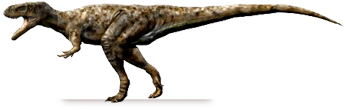
Pronunciation: doo-REE-a-veh-NAY-tuhr
Meaning: Dorset Hunter
Author/s: Benson (2008)
Synonyms: Megalosaurus hesperis
First Discovery: Dorset, UK
Acta Ordinal: #669
Duriavenator hesperis
The remains that would become Duriavenator were initially assigned to Megalosaurus bucklandi by Richard Owen in 1883. But they were used to raise a new species, Megalosaurus hesperis, by Waldman in 1974 because he, and Alick Walker before him, had an issue with its teeth. Tooth counting is not a bad way to separate carnivorous saurischians, and BMNH R.332 has way more teeth in both its upper and lower jaws than Megalosaurus bucklandi. But both its jaws and teeth also sport several features that are lacking in the critter that they were long assigned to, so Roger Benson severed their ties with Megalosaurus altogether in 2008 and gave them a brand-spanking new name—Duriavenator—"Dorset Hunter".
Strangely for an apex predator, Duriavenator was almost highjacked by a pesky human in the form of a friend of the late Sam Welles, who claimed that these very same fossils had already been renamed "Walkersaurus", the problem being: an official description in a peer-reviewed publication, which would have cemented its name on the roll call of dinosaurs, never actually materialised. Stranger still, the tooth count of Duriavenator is closest to Zanclodon cambrensis from Bridgend in Wales, which has spent seventeen decades being nudged all over the archosaurian family tree but may be a Triassic-aged crocodile ancestor.
Strangely for an apex predator, Duriavenator was almost highjacked by a pesky human in the form of a friend of the late Sam Welles, who claimed that these very same fossils had already been renamed "Walkersaurus", the problem being: an official description in a peer-reviewed publication, which would have cemented its name on the roll call of dinosaurs, never actually materialised. Stranger still, the tooth count of Duriavenator is closest to Zanclodon cambrensis from Bridgend in Wales, which has spent seventeen decades being nudged all over the archosaurian family tree but may be a Triassic-aged crocodile ancestor.
(Western Dorset hunter)Etymology
Duriavenator is derived from "Duria" (an old name for Dorset) and the Latin "venator" (hunter).
Not to be confused with a type of perennial herb with nocturnally fragrant flowers of the same name, the species epithet hesperis—a derivation of "hesperos" (western, of the west)—presumably refers to its discovery in the west (well, north-west) of Dorset.
Discovery
The remains of Duriavenator were discovered in the Inferior Oolite "on the north side of Cold Harbour Road", Sherborne, Dorset, UK, by a chap known only as "a friend of Mr. Edward Cleminshaw" in 1914.
The holotype (BMNH R.332) is a partial skull.


