









Pronunciation: PEL-ih-KAN-ih-MY-mus
Meaning: Pelican mimic
Author/s: Perez-Moreno et al. (1994)
Synonyms: None known
First Discovery: Cuenca, Spain
Acta Ordinal: #402
Pelecanimimus polyodon
With two hundred and twenty teeth in a rather long and shallow, Gallimimus-like snout, Pelecanimimus trumped every other ornithomimosaur whose gnashers generally numbered, well, none. Apart, that is, from Mongolia's Harpymimus (the first "bird mimic" discovered with teeth) and the 2003-named Shenzhousaurus from China, who had a comparatively measly 22 and 14-18 teeth respectively, but only in the tip of their lower jaws.
That tooth count is also far higher than in any theropod from any place or time, which ain't bad going for a roughly two-meter-long omnivore. But it also had different kinds, ranging from small, cylindrical and unserrated in the front of its jaws to sharp and blade-like in the back. So many teeth would suggest carnivory if there were any spaces between them. But the teeth of Pelecanimimus are so closely packed that they seem to form one continuous cutting surface, which would be replaced by another form of continuous cutting surface (a beak) in later bird mimic dinosaurs.
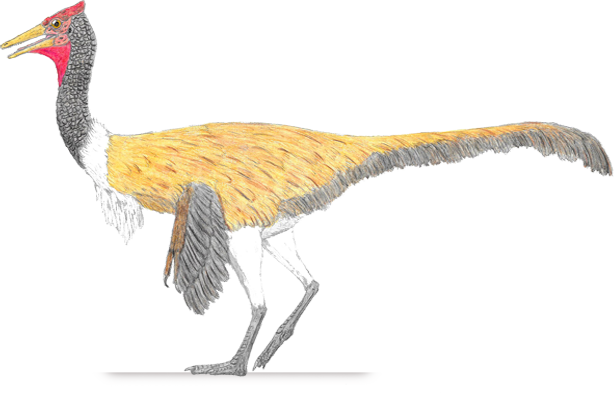
Discovered in Spain, Pelecanimimus is the first ornithomimosaur known from Europe, and it was found in Lagerstätte: a sedimentary layer renowned for extraordinary fossils with exceptional preservation of the finest details. A small crest was present on the back of the skull, and soft tissue attached to Palecanimimus suggests it may have sported a throat pouch much like a pelican, hence the name, meaning "Pelican mimic". Plus, it's the first of its kind to be found with a hyoid: a roughly horseshoe-shaped bone in the neck which provides an anchor point for the muscles of the tongue.
That tooth count is also far higher than in any theropod from any place or time, which ain't bad going for a roughly two-meter-long omnivore. But it also had different kinds, ranging from small, cylindrical and unserrated in the front of its jaws to sharp and blade-like in the back. So many teeth would suggest carnivory if there were any spaces between them. But the teeth of Pelecanimimus are so closely packed that they seem to form one continuous cutting surface, which would be replaced by another form of continuous cutting surface (a beak) in later bird mimic dinosaurs.
Discovered in Spain, Pelecanimimus is the first ornithomimosaur known from Europe, and it was found in Lagerstätte: a sedimentary layer renowned for extraordinary fossils with exceptional preservation of the finest details. A small crest was present on the back of the skull, and soft tissue attached to Palecanimimus suggests it may have sported a throat pouch much like a pelican, hence the name, meaning "Pelican mimic". Plus, it's the first of its kind to be found with a hyoid: a roughly horseshoe-shaped bone in the neck which provides an anchor point for the muscles of the tongue.
(Pelican mimic with many teeth)Etymology
Pelecanimimus is derived from the Latin "pelecanus" (pelican) and the Greek "mimos" (mimic), so named because of its unusually long, shallow face and impressions on the underside of its skull which may have been attachment points for a pelican-like gular pouch.
The species epithet, polyodon (po-LIE-o-don), is derived from the Greek "polys" (many) and "odon" (tooth).
Discovery
The remains of Pelecanimimus were discovered in Lagerstätte beds within the Calizas de La Huérguina Formation (aka La Huérguina Limestone or just La Huérguina) at Las Hoyas, Cuenca Province, Castilla-La Mancha, Spain, by Armando Díaz Romeral in July 1993. The holotype (LH 7777, housed at the Museo de Cuenca, Spain) includes the front half of a skeleton including the skull.


