









Pronunciation: BAH-gah-SEH-ruh-tops
Meaning: Small horn face
Author/s: Maryanska and Osmólska (1975)
Synonyms: See below
First Discovery: Ömnögovi, Mongolia
Acta Ordinal: #251
Bagaceratops rozhdestvensyi
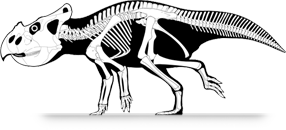
Although appearing quite late in the fossil record, Bagaceratops was a bit primitive, with its short and narrow neck frill, a low tooth count—only ten per jaw in adults—and a slender build typical of early ceratopsians. For years, the largest known skull was only 17cm long, and the smallest just 4.7—with the eye socket accounting for half of that—and paleontologists thought it well within the realms of possibility that its fossils were infant specimens of Protoceratops, itself a small ceratopsian. However, closer study revealed some unusual features, such as an extra opening in its skull just in front of the eye sockets that mirrors the nostril openings in both shape and size, and the faintest whiff of a low, blunt snout "horn", even in the smallest specimens. But no sooner had Bagaceratops been confirmed as a unique critter worthy of its own name than lumpers arrived, eager to fold other small protoceratopsids into it.
Second only to Protoceratops in sheer abundance, Bagaceratops has been discovered at Khulsan, Khermeen Tsav and Bayan Mandahu, areas which have also yielded remains of Lamaceratops, Platyceratops, Graciliceratops, Magnirostris, and Breviceratops, and some workers considered it entirely plausible that the so-called unique features which set them all apart were merely age- or gender-related quirks, or the result of compressive force during fossilisation. Of all the suggested synonyms, though, the most unlikely is Khulsan's Breviceratops, which was long considered a juvenile Bagaceratops, despite at least one skull rumoured to belong to a critter some 2 meters long. For a juvenile of that size to "grow into" an adult Bagaceratops would require a reverse growth curve whereby it shrank by at least a quarter while also shedding it's premaxillary teeth (blunt teeth near the tip of the upper jaw) and any trace of a nose horn! Unfortunately, that skull—along with jaws of Tarbosaurus efromovi and two skulls of Protoceratops andrewsi— were nicked from the fossil repository of the Palaeontological Institute at the Russian Academy of Sciences in August of 1996 and, as far as we know, has never been recovered.
Thanks to the restudy of dozens of small ceratopsian specimens from across Mongolia's Barun Goyot Formation by Czepinski in 2019, Bagaceratops has never been as well represented as it is now, with some referred skulls fully twice as long as the previous longest, which has upped its estimated total adult length to between 1 and 1.5 metres.
Second only to Protoceratops in sheer abundance, Bagaceratops has been discovered at Khulsan, Khermeen Tsav and Bayan Mandahu, areas which have also yielded remains of Lamaceratops, Platyceratops, Graciliceratops, Magnirostris, and Breviceratops, and some workers considered it entirely plausible that the so-called unique features which set them all apart were merely age- or gender-related quirks, or the result of compressive force during fossilisation. Of all the suggested synonyms, though, the most unlikely is Khulsan's Breviceratops, which was long considered a juvenile Bagaceratops, despite at least one skull rumoured to belong to a critter some 2 meters long. For a juvenile of that size to "grow into" an adult Bagaceratops would require a reverse growth curve whereby it shrank by at least a quarter while also shedding it's premaxillary teeth (blunt teeth near the tip of the upper jaw) and any trace of a nose horn! Unfortunately, that skull—along with jaws of Tarbosaurus efromovi and two skulls of Protoceratops andrewsi— were nicked from the fossil repository of the Palaeontological Institute at the Russian Academy of Sciences in August of 1996 and, as far as we know, has never been recovered.
Thanks to the restudy of dozens of small ceratopsian specimens from across Mongolia's Barun Goyot Formation by Czepinski in 2019, Bagaceratops has never been as well represented as it is now, with some referred skulls fully twice as long as the previous longest, which has upped its estimated total adult length to between 1 and 1.5 metres.
(Rozhdestvensky's Small Horn Face)Etymology
Bagaceratops is derived from the Mongolian "baga" (small), and the Greek "ceras" (horn) and "ops" (face).
The species epithet (or specific name), rozhdestvensyi, honours Russian paleontologist Anatoly Konstantinovich Rozhdestvensky.
Synonyms
Lamaceratops tereschenkoi (Alifanov, 2003)Magnirostris dodsoni (You and Dong 2003)
Platyceratops tatarinovi (Alifanov, 2003)
Gobiceratops minutus (Alifanov, 2008)
Discovery
The first remains of Bagaceratops were discovered in the red beds of "Khermeen Tsav I" (aka Khermin Tsav, Hermiin Tsav) within the Barun Goyot Formation, southwest of the Nemegt Basin in Ömnögovi, during Polish paleontological expeditions to Mongolia's Gobi Desert between 1963 and 1971.
The holotype (holotype ZPAL MgD-I/126) is a nearly complete skull with its lower jaw.
Referred material includes forty-one specimens from the Barun Goyot Formation: thirty-seven from Khermeen Tsav—among them Gobiceratops minutus (PIN 3142/299), Platyceratops tatarinovi (PIN 3142/4, then catalogued as PIN 3142/5), Lamaceratops tereschenkoi (PIN 3142/1), a specimen identified by Maryanska and Osmólska in 1975 as ?Protoceratops kozlowskii and reassigned to Breviceratops by Kurzanov in 1990 (ZPAL MgD-I/118), and three others that bypassed ?Protoceratops entirely and were assigned directly to Breviceratops (PIN 3142/2, PIN 3142/3, and PIN 3142/5, then catalogued as PIN 3142/4). Four specimens come from Khulsan, including the holotype of Lamaceratops tereschenkoi (PIN 4487/26), along with three specimens identified as ?Protoceratops kozlowskii by Maryanska and Osmólska in 1975 and transferred to Breviceratops by Kurzanov in 1990 (ZPAL MgD-I/118, ZPAL MgD-I/120, and IGM 100/3653). One further specimen, Magnirostris dodsoni (IVPP V 12513), comes from the Bayan Mandahu Formation.


