
LURDUSAURUS
a chonky iguanodontian ornithopod dinosaur from the Early Cretaceous of Niger.
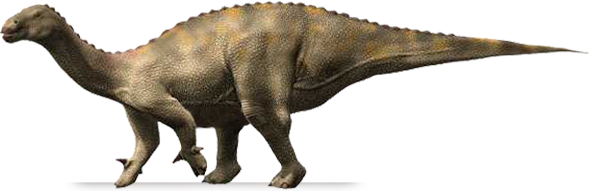
Pronunciation: LUR-doo-SOR-us
Meaning: Heavy lizard
Author/s: Taquet and Russell (
1999)
Synonyms: See
below
First Discovery: Gadoufaoua, Niger
Acta Ordinal: #462
Lurdusaurus arenatus
(Sandy Heavy Lizard)Etymology
Lurdusaurus is derived from the Latin "lurdus" (heavy) and the Greek "sauros" (lizard"), to indicate an unusual ornithopod dinosaur "heavy, both in weight and significance".
The
species epithet,
arenatus (ah-ree-NAY-tuhs) means "sandy" in latin, referring to the sandy desert region of Gadoufaoua in Niger, West Africa, where the fossils were found.
"Iguanodontidé trapu" (Taquet, 1976)
"
Gravisaurus tenerensis" (Chabli, 1988)
Discovery
The remains of
Lurdusaurus were discovered at "Camp des deux arbres" (Camp of the two trees) in the "GAD 5" layer of the Elrhaz Formation (Tegama Series), 100m from the holotype site of
Ouranosaurus nigeriensis in Gadoufaoua, 7 km South East of the wells of Elrhaz, Ténéré Desert, Niger, by Philippe Taquet in 1965. It was excavated in March 1966.
The
holotype (MNHN GDF 1700—previously GDF 301) is a partial skeleton and fragmentary skull. Referred material includes a huge right coracoid or shoulder bone
(also catalogued as GDF 381) and a lower jaw fragment (MNHN GDF 43G).
To add a touch of spice, the paratype specimen of
Ouranosaurus is also catalogued as GDF 381 (which might also be the "Viena Specimen"), meaning that code was used three times for three different specimens found in three different years.
Estimations
Timeline:
Era: Mesozoic
Epoch: Early Cretaceous
Stage: Albian
Age range: 112 mya
Stats:
Est. max. length: ?
Est. max. hip height: ?
Est. max. weight: ?
Diet: Herbivore
References
• Taquet P (1967) Découvertes paléontologiques récentes dans le nord du Niger" [Recent paleontological discoveries in the north of Niger]. Page 415-418 in "Problèmes
actuels de Paléontologie".
Éditions du Centre national de la recherche scientifique, Paris.
• Taquet P (1976) "Geologie et paleontologie du gisement de Gadoufaoua (Aptien du Niger)".
Cahiers de Paléontologie: 1-191.
• Chabli S (1988) "Étude anatomique et systématique de
Gravisaurus tenerensis (Dinosaurien Ornithischien) du gisement de Gadoufaoua (Aptien du Niger)".
Thèse présentée à l'université de Paris VII, UFR de biologie et des sciences de la nature. (Inédit).
• Taquet P and Russell DA (1999) "
A massively-constructed iguanodont from Gadoufaoua, Lower Cretaceous of Niger".
Annales de Paléontologie. 85(1): 85-96. DOI: 10.1016/s0753-3969(99)80009-3
• Norman DB (2004) "Basal Iguanodontia". Page 413-437 in Weishampel, Dodson and Osmolska (eds.) "
The Dinosauria: Second Edition".
• Taquet P (2012) "The African Cousins of the European Iguanodontids". Page 283-291 in Godefroit (ed.) "
Bernissart Dinosaurs and Early Cretaceous Terrestrial Ecosystems".
• Paul GS (2016) "
The Princeton Field Guide to Dinosaurs: Second Edition".
• Gônet J, Allain R and Houssaye A (2026) "Locomotor reassessment of
Iguanodon,
Ouranosaurus and
Lurdusaurus (Dinosauria, Ornithopoda) using osteological correlates".
Fossil Record, 29(1): 71-86. DOI: 10.3897/fr.29.173614.
Time stands still for no man, and research is ongoing. If you spot an error, or want to expand, edit or add a dinosaur, please use
this form. Go
here to contribute to our FAQ.
All dinos are GM free, and no herbivores were eaten during site construction!
To cite this page:
Atkinson, L.
"
LURDUSAURUS :: from DinoChecker's dinosaur archive".
‹
http://www.dinochecker.com/dinosaurs/LURDUSAURUS›. Web access: 23rd Oct 2026.









