









Pronunciation: oss-TROH-mee-uh
Meaning: For John Ostrom
Author/s: Foth and Rauhut (2017)
Synonyms: See below
First Discovery: Bavaria, Germany
Acta Ordinal: #992
Ostromia crassipes
Although Hermann von Meyer announced the first Archaeopteryx discovery in 1861, a fragmentary specimen was found 6 years earlier than that near Riedenburg in Bavaria, but it was misidentified as a pterosaur by the same von Meyer and assigned to Pterodactylus as a new species—Pterodactylus crassipes—in 1857. It was not until 1970 that the latter was correctly identified as a theropod dinosaur by John Ostrom, who referred it to Archaeopteryx cf. lithographica, and then it spent almost half a century being referred to simply as "the Haarlem specimen", because it was rediscovered loitering in the collections of Teylers Museum in Haarlem, Netherlands.
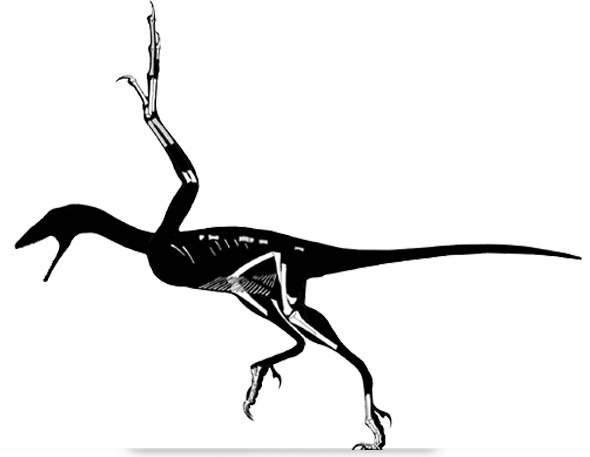
In 2017, Christian Foth and Oliver Rauhut realised that Ostrom's referral was not correct either, but they honoured him when they named the specimen Ostromia, regardless. The fossil preserves the knee region, a hand with claws, ribs, part of a pelvis and hindlimb, and feather impressions, and its proportions—an elongated third metacarpal, a small first manual ungual, straight longitudinal furrows along the finger bones, long metatarsals, and a backward-curving pubis with a triangular boot—match the anatomy of Anchiornis and other anchiornithids more closely than they do Archaeopteryx.
Although fragmentary, the specimen reveals a pigeon-sized, ground-running predator that hunted insects and small vertebrates in the Late Jurassic landscapes of southern Germany. Although feathered, its anatomy suggests agility rather than powered flight, and its presence in the Painten Formation shows that anchiornithids were not confined to China: they also lived in Europe, marking Ostromia as a key piece of the dinosaur–bird transition.
Ostromia was scanned and studied at Diamond Light Source in 2024 on their I18 beamline—using a combination of microfocus X-ray fluorescence imaging and absorption spectroscopy—to discover more about its features, including feather colour. The results have yet to be published.
In 2017, Christian Foth and Oliver Rauhut realised that Ostrom's referral was not correct either, but they honoured him when they named the specimen Ostromia, regardless. The fossil preserves the knee region, a hand with claws, ribs, part of a pelvis and hindlimb, and feather impressions, and its proportions—an elongated third metacarpal, a small first manual ungual, straight longitudinal furrows along the finger bones, long metatarsals, and a backward-curving pubis with a triangular boot—match the anatomy of Anchiornis and other anchiornithids more closely than they do Archaeopteryx.
Although fragmentary, the specimen reveals a pigeon-sized, ground-running predator that hunted insects and small vertebrates in the Late Jurassic landscapes of southern Germany. Although feathered, its anatomy suggests agility rather than powered flight, and its presence in the Painten Formation shows that anchiornithids were not confined to China: they also lived in Europe, marking Ostromia as a key piece of the dinosaur–bird transition.
Ostromia was scanned and studied at Diamond Light Source in 2024 on their I18 beamline—using a combination of microfocus X-ray fluorescence imaging and absorption spectroscopy—to discover more about its features, including feather colour. The results have yet to be published.
(Ostrom's Fat Foot)Etymology
Ostromia honours the late John Ostrom, who identified the Haarlem specimen as a theropod in 1970.
The species epithet, crassipes, is derived from the Latin "crassus" (fat, thick) and "pes" (foot).
Pterodactylus crassipes (Meyer, 1857)Rhamphorhynchus crassipes (Meyer, 1857)
Scaphognathus crassipes (Wagner, 1861)
Archaeopteryx cf. lithographica (Ostrom, 1970)
Discovery
The remains of Ostromia were discovered in the Painten Formation at Jachenhausen village, near Riedenburg, Bavaria, Germany, in 1855.
The holotype (TM 6928 and TM 6929) is part and counterpart of a fragmentary skeleton, preserved on two slabs.
A cast of the holotype resides in the collections of the Bayerische Staatssammlung für Paläontologie und Geologie in Munich, under the specimen number SNSB-BSPG 1971 I 211.


