









Pronunciation: yoo-ti-RAN-us
Meaning: Feathered tyrant
Author/s: Xu Xing et al. (2012)
Synonyms: None known
First Discovery: Liaoning, China
Acta Ordinal: #816
Yutyrannus huali
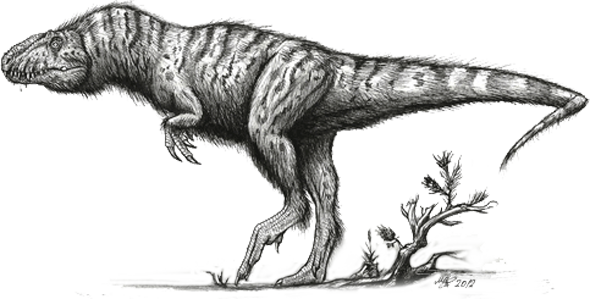
Palaeontologists have known for decades that some dinosaurs were "feathered". But they've mostly belonged to a group of theropods called Maniraptora, which includes therizinosaurs, oviraptorosaurs, alvarezsaurids and deinonychosaurs. And they've all been fairly small, with Beipiaosaurus being the largest at a little over two meters long. However, that all changed at Easter time 2012 with the discovery of Yutyrannus—the feathered tyrant—funnily enough, in the same area as Beipiaosaurus, which dramatically increased the size range of dinosaurs for which we have definite evidence of feathers.
Not only is Yutyrannus a tyrannosauroid and a primitive, three-fingered precursor to the colossal two-fingered tyrant lizards that bossed the latest Late Cretaceous and were scaley, but it's also nine meters long and a good ton and a half in weight. Its feathers, though, were nothing like the feathers of our modern flying friends. They were simple filaments that formed a coating more like the fuzzy down of a baby chick than the stiff plumes of an adult bird, and they were probably there for insulation during a much cooler-than-previously-thought Middle Cretaceous period.
Not only is Yutyrannus a tyrannosauroid and a primitive, three-fingered precursor to the colossal two-fingered tyrant lizards that bossed the latest Late Cretaceous and were scaley, but it's also nine meters long and a good ton and a half in weight. Its feathers, though, were nothing like the feathers of our modern flying friends. They were simple filaments that formed a coating more like the fuzzy down of a baby chick than the stiff plumes of an adult bird, and they were probably there for insulation during a much cooler-than-previously-thought Middle Cretaceous period.
(Beautiful feathered tyrant)
Etymology
Yutyrannus is derived from the Chinese Mandarin "yu" (feather) and the Latin "tyrannus" (tyrant).The species epithet, huali, means "beautiful" in Mandarin, referring to the beauty of the plumage of this animal.
Discovery
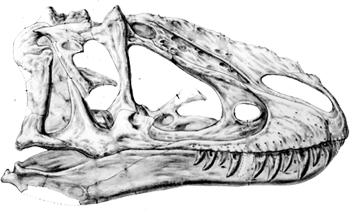 The remains of Yutyrannus were discovered in the Yixian Formation at Batuyingzi, Beipiao, Liaoning Province, China.
The holotype (ZCDM V5000—housed at the Zhucheng Dinosaur Museum in Shandong) is a semi-articulated, nearly complete adult skeleton with an estimated mass of 1.4 tons. A cast of this specimen is housed at the Institute of Vertebrate Paleontology and Paleoanthropology in Beijing, catalogued as IVPP FV1960. Paratypes include ZCDM V5001—a nearly complete, articulated skeleton, preserved on the same stone slab as the holotype, housed at the Zhucheng Dinosaur Museum in Shandong, and ELDM V1001—an articulated skeleton missing the tail, housed at the Erlianhaote Dinosaur Museum of Inner Mongolia. Both individuals are estimated to be at least eight years younger than ZCDM V5000, with respective masses of 596 kg and 493 kg.
Casts of the paratypes are also housed at the Institute of Vertebrate Paleontology and Paleoanthropology in Beijing, where they're catalogued as IVPP FV1961 and IVPP FV1962. All three specimens were acquired from a fossil dealer who stated they were found in the same quarry at Batuyingzi... but could not provide accurate locality data to prove which one.
Preparators
H. Wang, L. Xiang and R. Cao.


