









Pronunciation: TRIH-nee-SOR-uh
Meaning: Trini's lizard
Author/s: Coria et al. (2013)
Synonyms: None known
First Discovery: James Ross Island, Antarctica
Acta Ordinal: #851
Trinisaura santamartaensis
We remember when it used to snow in January. Bigger, older kids would pelt us in the face with snowballs, and we’d retaliate by pelting smaller, younger kids in return. We also remember being warned not to eat yellow snow, but at least one of us didn't listen.
We're both sad and glad that it doesn't snow much in January anymore, at least not in England. But January 2013 forced us to think about the white stuff again—not just because it snowed heavily for the first time in years, but because the first-named dinosaur of that year came from Antarctica, specifically from the Snow Hill Island Formation near Santa Marta Cove.
Trinisaura sports a combination of features also found in the Argentine Gasparinisaura, Anabisetia and Talenkahuen, and was the first ornithopod found in the Snow Hill Island Formation, the second ornithischian dinosaur named from Antarctica and, in fact, only the fourth dinosaur of any ilk known from that continent, until Morrosaurus was eventually described in 2016. The ankylosaur Antarctopelta is the first known Antarctic ornithischian and should've been the first-named Antarctic dinosaur, but it took so long to excavate and describe that Hammer's Cryolophosaurus snook in and stole the glory, and it was actually discovered five years later!
Specifically, Trinisaura belongs to a group of long-legged, swift-running ornithopod dinosaurs called Elasmaria, which was raised initially to house a small bunch of Patagonian critters that were united by the presence of tile-like mineralised intercostal (between the ribs) plates. However, the group has expanded somewhat since then, and now includes essentially all Cretaceous-aged non-hadrosaurid ornithopods known from Gondwana: the ancient landmass made up of modern day South America, Africa, Antarctica, Australia, India, and the Arabian Peninsula.
Trinisaura sports a combination of features also found in the Argentine Gasparinisaura, Anabisetia and Talenkahuen, and was the first ornithopod found in the Snow Hill Island Formation, the second ornithischian dinosaur named from Antarctica and, in fact, only the fourth dinosaur of any ilk known from that continent, until Morrosaurus was eventually described in 2016. The ankylosaur Antarctopelta is the first known Antarctic ornithischian and should've been the first-named Antarctic dinosaur, but it took so long to excavate and describe that Hammer's Cryolophosaurus snook in and stole the glory, and it was actually discovered five years later!
Specifically, Trinisaura belongs to a group of long-legged, swift-running ornithopod dinosaurs called Elasmaria, which was raised initially to house a small bunch of Patagonian critters that were united by the presence of tile-like mineralised intercostal (between the ribs) plates. However, the group has expanded somewhat since then, and now includes essentially all Cretaceous-aged non-hadrosaurid ornithopods known from Gondwana: the ancient landmass made up of modern day South America, Africa, Antarctica, Australia, India, and the Arabian Peninsula.
(Trini's Lizard from Santa Marta Cove)Etymology
Trinisaura combines "Trini" (for Dr. Trinidad "Trini" Diaz, pioneer of geologic studies on the Antarctic Peninsula) and the Greek "saura" (feminine form of "sauros", meaning "lizard").The species epithet, santamartaensis, is derived from "Santa Marta" (for Santa Marta Cove, where it was found) with the Latin "-ensis" (from).
Discovery
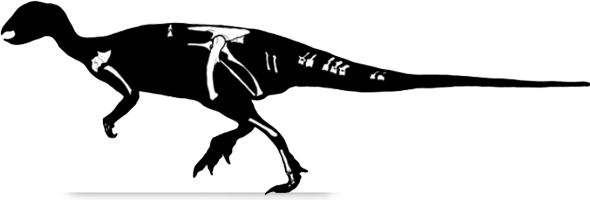
The remains of Trinisaura were discovered in the Snow Hill Island Formation (Marambio Group) at Santa Marta Cove, James Ross Island, Antarctica, by Rodolfo Coria and Juan Jose Moly, duing an Antarctic summer campaign supported by the Instituto Antártico Argentino, in 2008.The holotype (MLP-III-1-1) is a partial, skulless, skeleton, which includes one partial back vertebra, three partial hip vertebrae, seven tail vertebrae, two partial ribs, a partial right shoulder girdle, partial right humerus, a partial hip (both ilia, right pubis, right ischium), a right thigh, partial right shin, two hand bones, a partial foot bone, three toes bones, and some indeterminate fragments.
Preparator
E. Gómez of Museo Carmen Funes (MCF), Plaza Huincul, Neuquén, Argentina.


