
RHINOREX
a plant-eating saurolophine hadrosaurid dinosaur from the Late Cretaceous of North America.
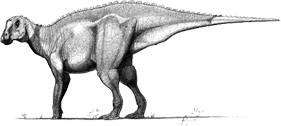
Pronunciation: ri-no-rex
Meaning: Nose king
Author/s: Gates and Scheetz (
2014)
Synonyms: None known
First Discovery: Utah, USA
Acta Ordinal: #896
Rhinorex condrupus
Aside from a still-unnamed tyrannosaur foot, the only confirmed dinosaurian remains from Utah's Book Cliffs belong to a hadrosaurid whose extensive skin impressions were described by Anderson et al. at the end of the 20th Century. But why didn't they give it a name? We have no idea, but we do know they missed out because it has one now — Rhinorex condrupus, the cliff-buried nose king — and Gates and Scheetz get the glory. Bless-id are the big noses.
(Nose king, buried in cliffs)Etymology
Rhinorex is derived from the Greek "rhino" (nose) and the Latin "rex" (king), in reference to its huge nose. The
species epithet,
condrupus, is derived from the Latin "condo" (bury) and "rupes" (cliffs), as it was buried within the Book Cliffs of Utah.
ZooBank registry:
urn:lsid:zoobank.org:act:8836709C-42FE-404C-A036-AD7C47D6C225.
Discovery
The first remains of
Rhinorex were discovered in the Neslen Formation (250 km north of the prolific dinosaur-bearing
Kaiparowits Formation), Thompson Canyon,
Grand County, central Utah, USA, by Brian Anderson and Roger Wagerle—students at the University of California at Riverside—in 1992.
The
holotype (BYU 13258) is a partial skeleton and skull.
Estimations
Timeline:
Era: Mesozoic
Epoch: Late Cretaceous
Stage: Campanian
Age range: 75 mya
Stats:
Est. max. length: 9 meters
Est. max. hip height: ?
Est. max. weight: 3.5 tons
Diet: Herbivore
References
• Anderson BG, Barrick RE, Droser ML and Stadtman KL 1999) "Hadrosaur skin impressions from the Upper Cretaceous Neslen Formation, Book Cliffs, Utah: morphology
and paleoenvironmental context".Page 295-301 in Gillette (ed.) "
Vertebrate Paleontology in Utah".
Utah Geological Survey, Salt Lake City.
• Gates TA and Scheetz R (2014) "A new saurolophine hadrosaurid (Dinosauria: Ornithopoda) from the Campanian of Utah, North America".
Journal of Systematic Palaeontology, 13(8): 711-725. DOI: 10.1080/14772019.2014.950614.
• Gates TA and Sampson SD (2007) "A new species of Gryposaurus (Dinosauria: Hadrosauridae) from the late Campanian Kaiparowits Formation, southern Utah, USA".
Zoological Journal of the Linnean Society, 151(2): 351-376. DOI: 10.1111/j.1096-3642.2007.00349.x.
Time stands still for no man, and research is ongoing. If you spot an error, or want to expand, edit or add a dinosaur, please use
this form. Go
here to contribute to our FAQ.
All dinos are GM free, and no herbivores were eaten during site construction!
To cite this page:
Atkinson, L.
"
RHINOREX :: from DinoChecker's dinosaur archive".
‹
http://www.dinochecker.com/dinosaurs/RHINOREX›. Web access: 22nd Oct 2026.









