









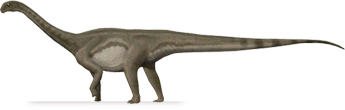
Pronunciation: PAT-a-go-SOR-us
Meaning: Patagonia lizard
Author/s: Bonaparte (1979)
Synonyms: Non known
First Discovery: Chubut, Argentina
Acta Ordinal: #282
Patagosaurus fariasi
Patagosaurus was discovered at Cerro Condor along with Volkheimeria chubutensis (a smaller, more primitive sauropod) and Piatnitzkysaurus floresi (a carnivorous megalosauroid who probably ate both of them), and was initially placed in Cetiosauridae —a group of chunky sauropods known as "whale lizards" — based on nothing more than its robust build.
Known from a dozen or so specimens and a clean sweep of growth stages from juvenile to geriatric, Patagosaurus is the best represented Jurassic-aged sauropod currently known from South America. However, German palaeontologist Oliver Rauhut reckons some of the remains that have been assigned to it may actually belong to a different type of sauropod.
Known from a dozen or so specimens and a clean sweep of growth stages from juvenile to geriatric, Patagosaurus is the best represented Jurassic-aged sauropod currently known from South America. However, German palaeontologist Oliver Rauhut reckons some of the remains that have been assigned to it may actually belong to a different type of sauropod.
(Ricardo Farias's Patagonian Lizard)Etymology
Patagosaurus is derived from "Patagonia" (the region of southern Argentina where it was found) and the Greek "sauros" (lizard). Apparently, Patagonia itself is derived from "Patagon", meaning "Bigfoot" in Spanish, and was named for the Bigfoot Indians, once thought to be giants, who inhabit this area.The species epithet, fariasi, honors villager Ricardo Farias who discovered the first fossils and allowed paleontologists to dig up his land in search of more.
Discovery
The first fossils of Patagosaurus were discovered in the
Cañadon Asfalto Formation, Sierre de Olte Group, 5 kilometers to the north of Cerro Cóndor (Cerro Cóndor North), Chubut Province, Patagonia, Argentina, and excavated by palaeontologists from the Fondacion Lillo, CONICET and the Universidad Nacional de Tucumán between 1978-1980.
The holotype (PVL 4170) is a partial skeleton, including vertebrae from the neck, back and tail, some ribs, hip bones, a partial shoulder blade, the right humerus (upper arm bone), right femur (thigh), and other bits and bobs.


