ORODROMEUS
a plant-eating orodromine ornithopod dinosaur from the Late Cretaceous of North America.

Pronunciation: OR-o-DROHM-ee-us
Meaning: Mountain runner
Author/s: Horner and Weishampel (
1998)
Synonyms: Laosaurus minimus?
First Discovery: Montana, USA
Acta Ordinal: #345
Orodromeus makelai
(Makela's Mountain Runner)Etymology
Orodromeus is derived from the Greek "oros" (mountain) in reference to the Egg Mountain site where it was found, and "dromeus" (runner) because of the animal's presumed cursorial (running) habits.
The
species epithet,
makelai, honors the late Robert Makela for his many dinosaur discoveries, among which was the
Orodromeus holotype.
Discovery
The first remains of
Orodromeus were discovered at "Egg Mountain" (the nesting ground of
Maiasaura) in the Two Medicine Formation at Willow Creek, Teton County, Montana, USA, by Robert Makela.
The
holotype (MOR 294) is juvenile skeleton missing the hands and tail. Referred material includes PP 22412 (a set of hindlimbs), MOR 331 (a partial skeleton), MOR 248 (a skeleton with skull), MOR 403 (a braincase) and MOR 473 (a disarticulated adult skeleton with a crushed skull). Egg clutches MOR 246 and MOR 750 turned out to be troodontid eggs.
Estimations
Timeline:
Era: Mesozoic
Epoch: Late Cretaceous
Stage: Campanian
Age range: 80-73 mya
Stats:
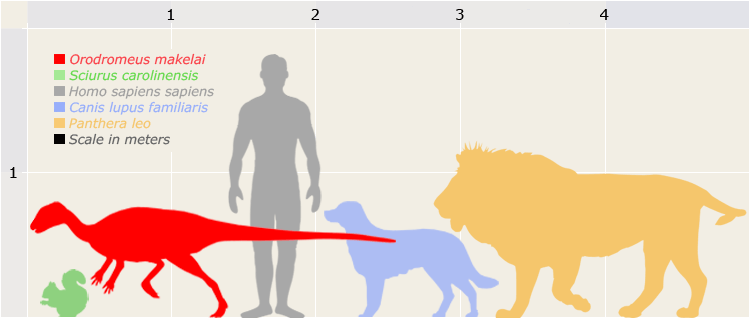
Est. max. length: 2.5 meters
Est. max. hip height: 0.7 meters
Est. max. weight: 45 Kg
Diet: Herbivore
References
• Horner JR and Weishampel DB (1988) "
A comparative embryological study of two ornithischian dinosaurs".
Nature, 332(6161): 256-257.
• Hirsch KE and Quinn B (1990) "Eggs and eggshell fragments from the Upper Cretaceous Two Medicine Formation of Montana".
Journal
of Vertebrate Paleontology, 10: 491-511.
• Horner JR and Weishampel DB (1996) "
A comparative embryological study of two ornithischian dinosaurs, a correction".
Nature, 383: 103-103.
• Varricchio DJ, Jackson F, Borkowski JJ and Horner JR (1997) "Nest and egg clutches of the dinosaur
Troodon formosus and the evolution of avian reproductive traits".
Nature, 385(6613): 247–250. DOI: 10.1038/385247a0
• Scheetz RD (1999) "
Osteology of Orodromeus makelai and the phylogeny of basal ornithopod dinosaurs".
Ph.D. Thesis in Biology, Montana State University (MSU), Bozeman, 189 pp.
• Varricchio DJ, Horner JR and Jackson FD (2002) "Embryos and eggs for the Cretaceous theropod dinosaur
Troodon formosus".
Journal of Vertebrate Paleontology, 22: 564–576. DOI: 10.1671/0272-4634(2002)022[0564:EAEFTC]2.0.
CO;2
• Varricchio DJ, Martin AJ and Katsura Y (2007) "
First trace and body fossil evidence of a burrowing, denning dinosaur".
Proc Biol Sci. 274(1616): 1361-1368. DOI: 10.1098/rspb.2006.0443
• Martin AJ (2005) "
Introduction to the Study of Dinosaurs".
• van der Reest AJ and Currie PJ (2017) "Troodontids (Theropoda) from the Dinosaur Park Formation, Alberta, with a description of a unique new taxon: implications for deinonychosaur diversity in North America".
Canadian Journal of Earth Sciences, 54(9): 919–935. DOI: 10.1139/cjes-2017-0031
Time stands still for no man, and research is ongoing. If you spot an error, or want to expand, edit or add a dinosaur, please use
this form. Go
here to contribute to our FAQ.
All dinos are GM free, and no herbivores were eaten during site construction!
To cite this page:
Atkinson, L.
"
ORODROMEUS :: from DinoChecker's dinosaur archive".
‹
http://www.dinochecker.com/dinosaurs/ORODROMEUS›. Web access: 25th Oct 2026.