









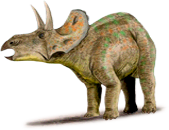
Pronunciation: die-SEH-ruh-tops
Meaning: Two horned face
Author/s: Lull (1905)
Synonyms: None known
First Discovery: Wyoming, USA
Acta Ordinal: #
Diceratops hatcheri
Diceratops was initially thought to be a specimen of Triceratops with a broken horn and battle-punctured neck frill. But it wasn't. It wasn't actually Diceratops either. That name had already been taken in 1869 by Förster (aka Foerster) and his hymenopteran wasp, which, ironically, turned out to be synonymous with the same author's Syzeuctus. But by the time Mateus got around to re-naming it Diceratus in 2008, Ukrainsky had already had a new name approved.
From the get-go, Diceratops oozed misfortune, spinning more bad luck than you would wish upon HMRC or the IRS. Even before the naming kerfuffle, its fossils were due to feature in O.C. Marsh's ceratopsian masterpiece, but he died in 1899 before it could be completed. John Bell Hatcher picked up the baton and endeavoured to complete the Triceratops section, but he too died, tragically young (42), in 1904, so the fossils remained nameless. In 1905, it fell to Richard Swann Lull to complete the monograph, in which he coined Diceratops. By 1933, though, Lull was having second thoughts about the critter's distinctness, so he proposed a new name, kind of, but still managed to keep the preoccupied one when he announced Triceratops (Diceratops) hatcheri. But at least he didn't die before the volume was finished.
After more attention than any vegetarian quadruped could possibly hope for, Diceratops is now officially known as Nedoceratops (Ukrainsky, 2007). And just to highlight this poor critter's serial misfortune one more time: some experts suspect Nedoceratops may be a specimen of Triceratops with a broken horn and battle-punctured neck frill after all.
From the get-go, Diceratops oozed misfortune, spinning more bad luck than you would wish upon HMRC or the IRS. Even before the naming kerfuffle, its fossils were due to feature in O.C. Marsh's ceratopsian masterpiece, but he died in 1899 before it could be completed. John Bell Hatcher picked up the baton and endeavoured to complete the Triceratops section, but he too died, tragically young (42), in 1904, so the fossils remained nameless. In 1905, it fell to Richard Swann Lull to complete the monograph, in which he coined Diceratops. By 1933, though, Lull was having second thoughts about the critter's distinctness, so he proposed a new name, kind of, but still managed to keep the preoccupied one when he announced Triceratops (Diceratops) hatcheri. But at least he didn't die before the volume was finished.
After more attention than any vegetarian quadruped could possibly hope for, Diceratops is now officially known as Nedoceratops (Ukrainsky, 2007). And just to highlight this poor critter's serial misfortune one more time: some experts suspect Nedoceratops may be a specimen of Triceratops with a broken horn and battle-punctured neck frill after all.
 • Lull RS (1905) “Restoration of the Horned Dinosaur Diceratops”.


