









Pronunciation: KONG-ko-RAP-tor
Meaning: Conch (shell) plunderer
Author/s: Barsbold (1986)
Synonyms: None known
First Discovery: Ömnögovi, Mongolia
Acta Ordinal: #330
Conchoraptor gracilis
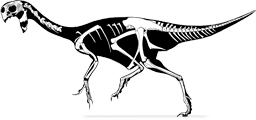
Conchoraptor was a bit modest in the head crest department, which led Rinchen Barsbold to assume it was an infant Oviraptor, and that elaborate head decor would arrive with maturity. As it happens, the only confirmed remains of Oviraptor are so smashed up that it's hard to tell if it even had a crest. And Barsbold's specimen turned out to be a bona fide adult specimen of an all-new genus that was later assigned to the Ingenia yanshini-anchored sub-family called Ingeniinae. But due diligence was sadly lacking.
Strictly speaking, both Ingenia and its Ingeniinae belong to Ingenia mirabilis, a bug that Gerlach christened a full 24 years before Barsbold named Ingenia yanshini the dinosaur. And with the latter waiting for a replacement name, it was in no position to be anchoring anything. Recently, Jesse Easter rechristened the dinosaur Ajancingenia, but it wasn't well-received. Etiquette dictates that coining authors get first dibs if their dinosaur needs renaming, so Easter had queue-jumped Barsbold. Furthermore, much of the paperwork that came with it was allegedly "borrowed" from a third party without a sniff of due credit. Nevertheless, the new name was official until 2017, when Barsbold and colleagues assigned Ajancingenia to Heyuannia in a thinly-veiled attempt to bury it. But some palaeontologists still use "Ingeniinae" (enclosed in quotes), which is understandable given the furore.
"Ingeniinae" is a subfamily within Oviraptoridae — a family of omnivorous theropod dinosaurs known colloquially as "egg snatchers" — whose members are renowned for their smooth, crestless noggins. Typically for this group, Conchoraptor is smaller than non-"ingeniine" oviraptorids, but its arms and legs are proportionately longer. Weight-saving holes riddle its skull, and CT scans of its braincase revealed evidence of sharp hearing, keen vision, and good balance and coordination. Theoretically, its robust beak was especially suited to cracking the shells of edible marine gastropods, the remnants of which are scattered throughout its fossil bed.
Strictly speaking, both Ingenia and its Ingeniinae belong to Ingenia mirabilis, a bug that Gerlach christened a full 24 years before Barsbold named Ingenia yanshini the dinosaur. And with the latter waiting for a replacement name, it was in no position to be anchoring anything. Recently, Jesse Easter rechristened the dinosaur Ajancingenia, but it wasn't well-received. Etiquette dictates that coining authors get first dibs if their dinosaur needs renaming, so Easter had queue-jumped Barsbold. Furthermore, much of the paperwork that came with it was allegedly "borrowed" from a third party without a sniff of due credit. Nevertheless, the new name was official until 2017, when Barsbold and colleagues assigned Ajancingenia to Heyuannia in a thinly-veiled attempt to bury it. But some palaeontologists still use "Ingeniinae" (enclosed in quotes), which is understandable given the furore.
"Ingeniinae" is a subfamily within Oviraptoridae — a family of omnivorous theropod dinosaurs known colloquially as "egg snatchers" — whose members are renowned for their smooth, crestless noggins. Typically for this group, Conchoraptor is smaller than non-"ingeniine" oviraptorids, but its arms and legs are proportionately longer. Weight-saving holes riddle its skull, and CT scans of its braincase revealed evidence of sharp hearing, keen vision, and good balance and coordination. Theoretically, its robust beak was especially suited to cracking the shells of edible marine gastropods, the remnants of which are scattered throughout its fossil bed.
(Gracile Shellfish Plunderer)Etymology
Conchoraptor is a derived from the Greek "konkhe" (mussel) and "raptor" (plunderer), referring to its assumed fondness for mollusks.
The species epithet, gracilis, means "slender" in Latin.
Discovery
The remains of Conchoraptor were discovered in the Red Beds of Hermiin Tsav in Mongolia's Nemegt Formation at Ömnögovi, by a Polish-Mongolian expedition in 1971.
The holotype (IGM 100/20) is a partial skeleton and skull, lacking the lower jaw.
Funnily enough, the holotypes of Conchoraptor and Adasaurus, which were both named and described by Barsbold (in 1986 and 1983 respectively), share the same catalogue number (IGM 100/20).
Two exceptionally preserved specimens, IGM 100/3006 (MPC-D 100/3006) and IGM 100/1203 (MPC-D 100/1203), that were collected during the 1997 joint expedition of the American Museum of Natural History and the Mongolian Academy of Science were referred to Conchoraptor in 2025.


