









Pronunciation: CRY-o-LOAF-o-SOR-us
Meaning: Frozen crested lizard
Author/s: Hammer and Hickerson (1994)
Synonyms: None known
First Discovery: Beardmore, Antarctica
Acta Ordinal: #400
Cryolophosaurus ellioti
You can be forgiven for assuming that Antarctic dinosaurs would have needed thick, woolly coats to survive the harsh year-round conditions. But back in Jurassic times, before the break-up of Gondwana, Antarctica was six hundred miles or so closer to the equator, and while no tropical paradise in the winter season, it was a damn sight warmer than it is today. Foliage flourished, foliage-eating herbivores thrived, and herbivore-eating carnivores prospered. Cryolophosaurus was one such carnivore.
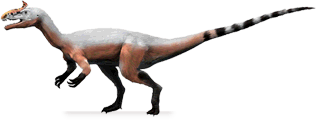
At one point informally known as "Elvisaurus" due to the resemblance of its head crest to Elvis Presley's fancy-dan "pompadour" hairdo, Cryolophosaurus has led palaeontologists a merry dance because of a weird combination of primitive and advanced characteristics. Its thighs have traits of early ceratosaurs, its ankle is fused like most ceratosaurs and abelisaurids, its hip is megalosauroid-grade, and its deep and narrow skull resembles much later-living tetanurans like North America's Allosaurus. Hammer and co. mused that perhaps it was a weird early ceratosaur sporting features of some large later-living tetanurans, or an earlier large tetanuran with some primitive features, or maybe an archaic abelisaurid. Later analyses came to a different conclusion.
In 2007, Nathan Smith suggested that Cryolophosaurus may belong to a family of medium-sized theropods close to both the Neoceratosauria ("new ceratosaurs") and Tetanurae ("stiff tails") along with Dilophosaurus and Dracovenator. All research since has failed to find robust support for this clade, informally known as "Dilophosauridae". But wherever Cryolophosaurus eventually settles, it's currently the largest known Early Jurassic theropod of any stamp, and the only known specimen is not fully grown.
Although Antarctopelta was the first dinosaur to be discovered in Antarctica, it took so long to excavate and describe that Cryolophosaurus was found half a decade later and took William Hammer another two seasons to literally jack-hammer out of the ground, but it still won the "first officially named Antarctic dinosaur" title by some twelve years. Apparently, its skull was smashed by shifting glaciers long before William and Jack arrived.
At one point informally known as "Elvisaurus" due to the resemblance of its head crest to Elvis Presley's fancy-dan "pompadour" hairdo, Cryolophosaurus has led palaeontologists a merry dance because of a weird combination of primitive and advanced characteristics. Its thighs have traits of early ceratosaurs, its ankle is fused like most ceratosaurs and abelisaurids, its hip is megalosauroid-grade, and its deep and narrow skull resembles much later-living tetanurans like North America's Allosaurus. Hammer and co. mused that perhaps it was a weird early ceratosaur sporting features of some large later-living tetanurans, or an earlier large tetanuran with some primitive features, or maybe an archaic abelisaurid. Later analyses came to a different conclusion.
In 2007, Nathan Smith suggested that Cryolophosaurus may belong to a family of medium-sized theropods close to both the Neoceratosauria ("new ceratosaurs") and Tetanurae ("stiff tails") along with Dilophosaurus and Dracovenator. All research since has failed to find robust support for this clade, informally known as "Dilophosauridae". But wherever Cryolophosaurus eventually settles, it's currently the largest known Early Jurassic theropod of any stamp, and the only known specimen is not fully grown.
Although Antarctopelta was the first dinosaur to be discovered in Antarctica, it took so long to excavate and describe that Cryolophosaurus was found half a decade later and took William Hammer another two seasons to literally jack-hammer out of the ground, but it still won the "first officially named Antarctic dinosaur" title by some twelve years. Apparently, its skull was smashed by shifting glaciers long before William and Jack arrived.
(David Elliot's Frozen Crest)Etymology
Cryolophosaurus is derived from the Greek "kryos" (cold, frozen), "lophos" (crest) and "sauros" (lizard), referring to the freezing conditions under which it was extracted and its unusual crest. The species epithet, ellioti, honours Ohio geologist David Elliot who made the initial discovery.
Discovery
The remains of Cryolophosaurus were discovered in the Hanson Formation (formerly the upper Falla Formation), 4,100 meters up Mount Kirkpatrick, Queen Alexandra Range, by David Elliot in 1990-91, alongside Glacialisaurus, a small pterosaur, a rat-sized tritylodont, and an as-yet unidentified theropod. Fossilized tree trunks lay two meters away.
The holotype (FMNH PR1821) includes a partially-crushed skull, a jaw bone (mandible), parts of the backbone (30 vertebrae), hip bones (the ilium, ischium, and pubis), leg bones (femur and fibula), an ankle joint (tibiotarsus) and foot bones (metatarsals).
 • Smith ND, Makovicky PJ, Hammer WR and Currie PJ (2007) "Osteology of Cryolophosaurus ellioti (Dinosauria:
Theropoda) from the Early Jurassic of Antarctica and implications for early theropod evolution".
• Smith ND, Makovicky PJ, Hammer WR and Currie PJ (2007) "Osteology of Cryolophosaurus ellioti (Dinosauria:
Theropoda) from the Early Jurassic of Antarctica and implications for early theropod evolution". 


