









Pronunciation: pro-SOR-o-LOH-fus
Meaning: Before Saurolophus
Author/s: Barnum Brown (1916)
Synonyms: See below
First Discovery: Alberta, Canada
Acta Ordinal: #121
Prosaurolophus maximus
Barnum Brown discovered the first remains of Prosaurolophus maximus in what he described as the Belly River Formation at Sand Creek in 1915. But, although it's now well-represented by dozens of individuals of different growth stages that account for 20% of all hadrosaurids known from Dinosaur Provincial Park, it remains obscure. Workers have found at least ten skulls since the description of the holotype, but none had been described in detail until 2013, and only two had been figured, including the one that Lull and Wright used in 1942 to show that Brown had incorrectly reconstructed the holotype with an exceedingly long snout. Palaeontologists seemingly don't have much spare love to show Prosaurolophus, but that's understandable; looking at it alongside some of its weird and wonderful family members is a bit like looking at a donkey in a field full of unicorns.
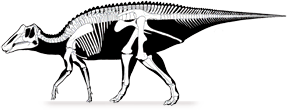
Prosaurolophus is a hadrosaurid, and as such, it has a broad, flat, duck-billed snout and banks of leaf-decimating teeth. But it's a sign of how unremarkable this critter is when a small triangular crest in front of its eyes with a depression on each side and proportionately short upper arms are its most striking features. Palaeontologists have spent decades arguing over Hadrosauridae, how to group its members and what those groups are called, while Prosaurolophus hasn't had a sniff of the speculative features furore that almost all dinosaurs endure. Apart from one time. In 2019, Eamon Drysdale concluded that the crest of Prosaurolophus grew proportionately throughout the lifetime of its owner and that the depression on each side may have housed soft tissue for a display more impressive than the crest itself, meaning even the kids could've had inflatable nostril sacs.
Prosaurolophus is a hadrosaurid, and as such, it has a broad, flat, duck-billed snout and banks of leaf-decimating teeth. But it's a sign of how unremarkable this critter is when a small triangular crest in front of its eyes with a depression on each side and proportionately short upper arms are its most striking features. Palaeontologists have spent decades arguing over Hadrosauridae, how to group its members and what those groups are called, while Prosaurolophus hasn't had a sniff of the speculative features furore that almost all dinosaurs endure. Apart from one time. In 2019, Eamon Drysdale concluded that the crest of Prosaurolophus grew proportionately throughout the lifetime of its owner and that the depression on each side may have housed soft tissue for a display more impressive than the crest itself, meaning even the kids could've had inflatable nostril sacs.
Etymology
Prosaurolophus is derived from the Greek "pro" (before) and "Saurolophus", named for its presumed ancestral relationship to Saurolophus.
The species epithet, maximus, means "largest" in Latin.
Discovery
The first remains of Prosaurolophus maximus were discovered in what is now known as the Dinosaur Park Formation, north fork of Sand Creek, Red Deer River, near Steveville, Alberta, Canada, by Barnum Brown in 1915.
(Brown called this the "Belly River formation"). The holotype (AMNH 5386) is an incomplete skull. Parts of the upper jaw were found detached from the rest of the skull and reconstructed incorrectly, resulting in a snout that was too long.


