









Pronunciation: chee-an-long
Meaning: Qian Dragon
Author/s: Han et al. (2023)
Synonyms: None known
First Discovery: Guizhou, China
Acta Ordinal: #1144
Qianlong shouhu
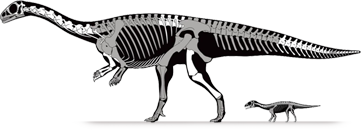
Qianlong shouhu is a sauropodomorph dinosaur from the Early Jurassic of southwestern China, near Anshun in Guizhou Province, where three adult skeletons were found resting close to five clutches of embryo-bearing eggs—just a metre or three from the nests. This rare association opens a small window onto dinosaur reproduction long before the Cretaceous, a period so poor in eggs and nesting traces that scientists still debate whether the scarcity reflects poor preservation or a genuine evolutionary shift toward thicker, harder eggshells later in dinosaur history.
The skull and lower jaw of Qianlong echo the familiar profile of other early sauropodomorphs: a long snout, large nostril openings set far forward and low on the face, and a lower jaw in which the main tooth-bearing bone makes up more than half the jaw’s length and curves slightly downward at the tip. Yet several features set it apart. Its teeth are straight, lack serrations, and are uneven in cross-section; the jaw joint sits lower than the top edge of the main tooth-bearing bone; and the bones of the upper and lower jaw show clear openings for blood vessels and nerves. In the limbs, the first bone of the hand is broader than it is long, and the fifth bone of the foot has a strongly expanded upper end—about four times wider than the lower end—with a small bulge along its outer edge.
Qianlong embryos display several characteristics shared with the adults, but also some key differences. The embryos had proportionately longer front limbs and larger shoulder girdles than the adults. Cross-sections of the limb bones show the same trend: in embryos, the upper arm bone is almost the same size as the thigh bone, but in adults the thigh bone is much larger. This pattern suggests that hatchlings probably walked on all fours, only shifting toward a more upright, two-legged stance as they grew—a developmental arc thought to be common among early sauropodomorphs. The eggs themselves are rough-textured, irregular shaped, and match the thickness and breakage patterns of modern reptile eggs, suggesting a similarly tough-but-flexible shell. Taken together, their features and Early Jurassic age provide strong evidence for the earliest known leathery dinosaur eggs.
The skull and lower jaw of Qianlong echo the familiar profile of other early sauropodomorphs: a long snout, large nostril openings set far forward and low on the face, and a lower jaw in which the main tooth-bearing bone makes up more than half the jaw’s length and curves slightly downward at the tip. Yet several features set it apart. Its teeth are straight, lack serrations, and are uneven in cross-section; the jaw joint sits lower than the top edge of the main tooth-bearing bone; and the bones of the upper and lower jaw show clear openings for blood vessels and nerves. In the limbs, the first bone of the hand is broader than it is long, and the fifth bone of the foot has a strongly expanded upper end—about four times wider than the lower end—with a small bulge along its outer edge.
Qianlong embryos display several characteristics shared with the adults, but also some key differences. The embryos had proportionately longer front limbs and larger shoulder girdles than the adults. Cross-sections of the limb bones show the same trend: in embryos, the upper arm bone is almost the same size as the thigh bone, but in adults the thigh bone is much larger. This pattern suggests that hatchlings probably walked on all fours, only shifting toward a more upright, two-legged stance as they grew—a developmental arc thought to be common among early sauropodomorphs. The eggs themselves are rough-textured, irregular shaped, and match the thickness and breakage patterns of modern reptile eggs, suggesting a similarly tough-but-flexible shell. Taken together, their features and Early Jurassic age provide strong evidence for the earliest known leathery dinosaur eggs.
(Guarding Qian Dragon)Etymology
Qianlong is derived from Mandarin Chinese "Qian" (an alternative name for Guizhou Province where the fossils were found) and "long" (dragon). Coincidentally, Qianlong (1711-1799) is also the name of the fifth emperor of the Qing dynasty, the fourth to rule over China proper, and one of the longest-reigning monarchs in history.
The species epithet, shouhu, means "guarding" in Chinese, referring to the adult skeletal fossils that were "guarding" the associated embryo-containing egg fossils at the site.
Discovery
The first remains of Qianlong were discovered in the Zhenzhuchong Member of the Ziliujing Formation at Zhuanpo, Pingba District, Anshun City, Guizhou Province, southwestern China, by local brickmakers in 1999. They were excavated by a team led by Huiyang Cai of Guizhou Provincial Museum and Xinjin Wang of Guizhou Provincial Institute of Cultural Relics and Archaeology between 10th August and 12th December of that year. A second excavation was organised for 2000, but the dig was abandoned because most of the fossil-bearing strata had been removed by locals as they continued their hunt for brickmaking red clay.
The holotype (GZPM VN001) is a partial, semi-articulated skeleton, and a partial skull and jaws found 30 metres away.
Referred material includes two partial, semi-articulated skeletons (GZPM VN002 and 003) and five clutches of embryo-containing eggs (GZPM VN004—008), the microstructural study of which led scientists to believe that Qinlong laid leathery eggs—neither hard-shelled nor soft-shelled—and that was likely the ancestral state for dinosaur eggs.
All fossils are housed at the Guizhou Provincial Museum (GZPM).
Preparator
Jinchao Ding.


