TONGTIANLONG
an omnivorous oviraptorid theropod dinosaur from the Late Cretaceous of China.
Pronunciation: TONG-tee-YEN-long
Meaning: Tongtian dragon
Author/s: Lü, Chen, Brusatte,
et al. (
2016)
Synonyms: None known
First Discovery: Jiangxi Province, China
Acta Ordinal: #952
Tongtianlong limosus
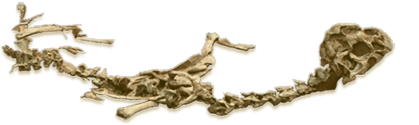
Tongtianlong is the sixth diagnostic oviraptorosaur from the Ganzhou area, being represented by a naturally articulated specimen, splendidly well-preserved in three dimensions, with its limbs splayed to the side, its neck outstretched and curved upwards, and its highly domed, toothless skull raised above its body. Typically for oviraptorosaurs from the Nanxiong Formation, Tongtianlong was collected non-professionally, in this case by a local farmer and workers at an active construction site, so any clues regarding its unusual posture were lost. Also lost were the arm ends, right pelvic girdle and hind leg, and parts of the tail when the specimen was exposed by workmen blasting away surrounding rock with explosives, but judging by an eye-watering drill hole right by its pelvis where TNT was inserted, it's a miracle there's as much of it as there is.
(Muddy Tongtian dragon)Etymology
Tongtianlong is derived from the Chinese Pinyin "Tongtian" (referring to Tongtianyan of Ganzhou; the first grotto south of the Yangtze River) and "long" (dragon). Tongtian also means "the road to heaven", which is a fitting epitaph for a deceased dinosaur preserved looking up with outstretched arms. The
species epithet,
limosus, means "muddy" in Latin, and refers to the discovery of the holotype in a mudstone.
Discovery
The remains of
Tongtianlong were discovered in the Nanxiong Formation at the building site of the No. 3 high school of Ganxian, near Ganzhou, Jiangxi Province, southern China, by a local farmer.
The
holotype (DYM-2013-8) is a nearly complete, three-dimensionally preserved skeleton with skull and lower jaws.
Preparators
Zhang Yuqing.
Estimations
Timeline:
Era: Mesozoic
Epoch: Late Cretaceous
Stage: Maastrichtian
Age range: 67-66 mya
Stats:
Est. max. length: ?
Est. max. hip height: ?
Est. max. weight: ?
Diet: Omnivore
References
• Barsbold R, Maryanska T and Osmólska H (1990) "Oviraptorosauria". Page 249-258 in Weishampel, Dodson and Osmolska (eds.) "
The Dinosauria: First Edition".
• Xu X and Han FL (2010) "
A new Oviraptorid dinosaur (Theropoda: Oviraptorosauria) from the upper Cretaceous of China".
 Vertebrata Palasiatica, 48(1): 11-18. [Banji long.]
• Wang S, Sun C, Sullivan C and Xu X (2013) "
A new oviraptorid (Dinosauria: Theropoda) from the Upper Cretaceous of southern China".
Zootaxa, 3640(2): 242-251. DOI: 10.11646/zootaxa.3640.2.7. [Ganzhousaurus nankangensis.]
• Wei XF, Pu HY, Xu L, Liu D and Lü JC (2013) "A new oviraptorid dinosaur (Theropoda: Oviraptorosauria) from the Late Cretaceous of Jiangxi Province, southern China".
Acta Geologica Sinica, 87: 899-904. [Jiangxisaurus ganzhouensis.]
• Lü JC, Yi LP, Zhong H and Wei XF (2013) "A new oviraptorosaur (Dinosauria: Oviraptorosauria) from the Late Cretaceous of Southern China and its paleoecological implications".
PLoS ONE, 8(11): e80557. DOI: 10.1371/journal.pone.0080557. [Nankangia jiangxiensis.]
• Junchang Lü, Hanyong Pu, Kobayashi Y, Li Xu, Chang H, Shang Y, Liu D, Lee Y-N, Kundrát M and Shen C (2015) "A new oviraptorid Dinosaur (Dinosauria: Oviraptorosauria) from the Late Cretaceous of Southern China and its paleobiogeographical implications".
Scientific Reports, 5: 11490. DOI: 10.1038/srep11490. [Huanansaurus ganzhouensis.]
• Lü J, Chen R, Brusatte SL, Zhu Y and Shen C (2016)
"A Late Cretaceous diversification of Asian oviraptorid dinosaurs: evidence from a new species preserved in an unusual posture".
Scientific Reports, 6(1): 35780. DOI: 10.1038/srep35780.
Time stands still for no man, and research is ongoing. If you spot an error, or want to expand, edit or add a dinosaur, please use
this form. Go
here to contribute to our FAQ.
All dinos are GM free, and no herbivores were eaten during site construction!
To cite this page:
Atkinson, L.
"
TONGTIANLONG :: from DinoChecker's dinosaur archive".
‹
http://www.dinochecker.com/dinosaurs/TONGTIANLONG›. Web access: 25th Oct 2026.