




Pronunciation: joh-BAH-ree-uh
Meaning: for Jobar (a Tuareg mythical beast)
Author/s: Sereno, Beck, Dutheil, et al. (1999)
Synonyms: None known
First Discovery: Sahara, Niger
Acta Ordinal: #469
Jobaria tiguidensis
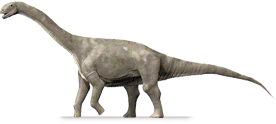
Jobaria is by far the most completely known African sauropod, and with 95% of its skeleton available for scrutiny eleven co-authors were quick to pin-point a hatful of quirks. Its neck was only twelve vertebrae long, its skull, spine and tail were of simple design and it had chisel-like teeth, which are all remarkably primitive features for a thought-to-be Cretaceous-aged critter. But when the Tiourarén Formation was re-dated and pushed way back into the Mid-Jurassic these features became remarkably unremarkable and Jobaria now relies on parallels drawn with the physics of a modern animal to drum up the faintest whiff of excitement.
Because the circumference of its hind legs is 1.5 times bigger than the front ones and has wider feet, it seems that the rear end of Jobaria was built to carry the lion's share of its body weight. After comparing this to a modern elephant (whose body weight distribution and larger leg circumference are exactly the opposite way around, by the way), speculation is rife that Jobaria could also rear up on its hind legs, and without a huge and heavy tusked skull, it could do it with a lot less effort.
Some palaeontologists have surmised that protective Jobaria parents could rear up and adopt a tripedal stance, using their tail as a supportive "third leg", as a means to ward off attacks on their young by the area's apex predator, Afrovenator. This could explain how an infant Jobaria came to sport bite scars on its ribs that had fully healed and so weren't fatal. But nothing is foolproof, and shed Afrovenator teeth found mingled with a mangled Jobaria specimen suggest that the whole rearing up thing, if they did or even could, was a far from perfect strategy. That's assuming, of course, that the teeth weren't merely lost by a carcass scavenger.
Because the circumference of its hind legs is 1.5 times bigger than the front ones and has wider feet, it seems that the rear end of Jobaria was built to carry the lion's share of its body weight. After comparing this to a modern elephant (whose body weight distribution and larger leg circumference are exactly the opposite way around, by the way), speculation is rife that Jobaria could also rear up on its hind legs, and without a huge and heavy tusked skull, it could do it with a lot less effort.
Some palaeontologists have surmised that protective Jobaria parents could rear up and adopt a tripedal stance, using their tail as a supportive "third leg", as a means to ward off attacks on their young by the area's apex predator, Afrovenator. This could explain how an infant Jobaria came to sport bite scars on its ribs that had fully healed and so weren't fatal. But nothing is foolproof, and shed Afrovenator teeth found mingled with a mangled Jobaria specimen suggest that the whole rearing up thing, if they did or even could, was a far from perfect strategy. That's assuming, of course, that the teeth weren't merely lost by a carcass scavenger.
(Jobar from Falaise de Tiguidi)Etymology
Jobaria is named after "Jobar", a creature from Tuareg folklore thought, by locals, to own the exposed fossil-bones. The species epithet, tiguidensis (TI-GI-DEN-SIS), refers to "Falaise de Tiguidi", the cliff at the base of which Jobaria remains were discovered.
Discovery
The remains of Jobaria were discovered in the Tiourarén Formation (Irhazer Group), Tamerát, In Gall, Niger. Once thought to be Early Cretaceous (136 to 125 mya) in age, re-study dated this Formation to the Middle Jurassic (176 to 161 mya). Its holotype (MNN TIG3) is a 95% complete skeleton.


