









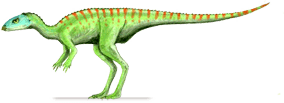
Pronunciation: gas-pah-REE-nee-SOR-uh
Meaning: Gasparini's lizard
Author/s: Coria and Salgado (1996)
Synonyms: None known
First Discovery: Río Negro, Argentina
Acta Ordinal: #415
Gasparinisaura cincosaltensis
Initially announced as the first basal iguanodontian known from South America, the teeny Gasparinisaura is one of just a few dinosaurs to be suffixed with the feminine form of lizard ("saura") rather than the masculine form ("saurus"), not because palaeontologists thought that the type specimen was a female but because it was named after female paleontologist Zulma Brandoni de Gasparini.
Gasparinisaura is also the first and still one of only a handful of non-sauropod herbivorous dinosaurs to be discovered with gastroliths (stomach stones): small stones which are swallowed by animals that lack grinding teeth to pulverise plant material and so aid digestion. Oftentimes, ground-grazing critters will accidentally swallow the odd stone that has become tangled within roots and whatnot, but the quantity (100+), type, shape and size of the stones, and the discovery of similar clusters in three separate specimens of Gasparinisaura, make accidental swallowing highly unlikely.
Gasparinisaura is also the first and still one of only a handful of non-sauropod herbivorous dinosaurs to be discovered with gastroliths (stomach stones): small stones which are swallowed by animals that lack grinding teeth to pulverise plant material and so aid digestion. Oftentimes, ground-grazing critters will accidentally swallow the odd stone that has become tangled within roots and whatnot, but the quantity (100+), type, shape and size of the stones, and the discovery of similar clusters in three separate specimens of Gasparinisaura, make accidental swallowing highly unlikely.
(Gasparini's lizard from Cinco Saltos)Etymology
Gasparinisaura is derived from "Gasparini" (for Zulma Brandoni de Gasparini) and the Greek "saura" (seldom-used feminine form of the masculine "sauros" meaning "lizard"). Other examples are Bonitasaura and Maiasaura.
The species epithet, cincosaltensis, refers to its discovery near Cinco Saltos.
Discovery
The remains of Gasparinisaura were discovered in the Anacleto Formation (Río Colorado Subgroup, Neuquén Group), near Cinco Saltos, Río Negro Province, Argentina, in 1992.
The holotype (MUCPv-208) is a partial skeleton.


