









Pronunciation: YOO-tah-SEH-ruh-tops
Meaning: Utah Horned Face
Author/s: Sampson et al. (2010)
Synonyms: None known
First Discovery: Utah, USA
Acta Ordinal: #753
Utahceratops gettyi
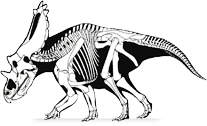
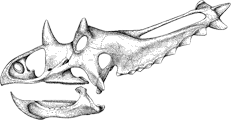
When palaeontologist Mark Loewen of Utah's Museum of Natural History discovered Utahceratops in Grand Staircase-Escalante National Monument he described it as "a giant rhino with a ridiculously supersized head". It wasn't just big though, it was also choc-a-block with unique features. Unlike almost all other ceratopsids—the family of horn-faced critters to which Utahceratops belongs—its relatively large nose horn is positioned high on its snout, sprouting from an area almost entirely behind its nostrils, and its short, blunt and robust brow horns point sideways rather than upwards, a bit like modern cow.
Unusually amongst chasmosaurines and unheard of in the other branch of ceratopsids; the centrosaurines, Utahceratops lived alongside fellow chasmosaurine Kosmoceratops which, funnily enough, has similarly angled horns. The latter, however, is smaller, its brow horns are much longer and curved, its nose "horn" is flat and blade-like and its frill is shorter, broader and adorned with ten well developed hooks that curve forwards and down over the frill. Because the two shared the same time and place it has been suggested that they may represent growth stages or different gender of the same species, but they're not even each others closest relatives, so how come they were both so mind-blowingly different compared to chasmosaurines from elsewhere?
For around 27 million years of the Late Cretaceous (95–68 Mya) the Western Interior Seaway flooded central North America, forming two landmasses known as Appalachia (to the east) and the smaller, thinner, wet and swampy Laramidia (to the west). On top of that, the authors of Utahceratops are championing a theory that chasmosaurines rose on Laramidia between 90-80 mya and had dispersed continent-wide by 77 mya, at which point the south became separated from the north by an ancient natural barrier located in the region of present day northern Utah and Colorado, and so species either side of it evolved their own design quirks. Of the dozens of chasmosaurines currently known only Vagaceratops irvinensis has been found in both northern and southern Laramidia, and its age suggests that this impediment, if there really was one, must have tumbled down around 75.7 mya, affording previously segregated critters the freedom of the continent.
Unusually amongst chasmosaurines and unheard of in the other branch of ceratopsids; the centrosaurines, Utahceratops lived alongside fellow chasmosaurine Kosmoceratops which, funnily enough, has similarly angled horns. The latter, however, is smaller, its brow horns are much longer and curved, its nose "horn" is flat and blade-like and its frill is shorter, broader and adorned with ten well developed hooks that curve forwards and down over the frill. Because the two shared the same time and place it has been suggested that they may represent growth stages or different gender of the same species, but they're not even each others closest relatives, so how come they were both so mind-blowingly different compared to chasmosaurines from elsewhere?
For around 27 million years of the Late Cretaceous (95–68 Mya) the Western Interior Seaway flooded central North America, forming two landmasses known as Appalachia (to the east) and the smaller, thinner, wet and swampy Laramidia (to the west). On top of that, the authors of Utahceratops are championing a theory that chasmosaurines rose on Laramidia between 90-80 mya and had dispersed continent-wide by 77 mya, at which point the south became separated from the north by an ancient natural barrier located in the region of present day northern Utah and Colorado, and so species either side of it evolved their own design quirks. Of the dozens of chasmosaurines currently known only Vagaceratops irvinensis has been found in both northern and southern Laramidia, and its age suggests that this impediment, if there really was one, must have tumbled down around 75.7 mya, affording previously segregated critters the freedom of the continent.
(Mike Getty's Utah Horned Face)Etymology
Utahceratops is derived from "Utah" (its US state of discovery) and the Greek "ceras" (horn) and "ops" (face).The species epithet (or specific name), gettyi (get-EE-i), honors Mike Getty, collections manager at the Utah Museum of Natural History, who discovered this behemoth in 2000. ZooBank registry: urn:lsid:zoobank.org:act:9F099FBB-D4C9-48FA-A5E9-388915FA1A05.
Discovery
 The remains of Utahceratops were discovered in the Kaiparowits Formation, Grand Staircase-Escalante National Monument, southern Utah, USA, which during the mid-late Cretaceous was part of the lost island continent of Laramidia, separated from Eastern North America—Appalachia—by a shallow sea known as the Western Interior Seaway.
The holotype (UMNH VP 16784) is a partial skull, about 2.3 m long.


