









Pronunciation: ahs-tro-don
Meaning: Star Tooth
Author/s: Leidy (1865)
Synonyms: Pleurocoelus?
First Discovery: Maryland, USA
Acta Ordinal: #22
Astrodon johnstoni
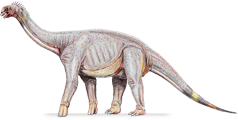
Originally named "Astrodontosaurus" (star tooth lizard) because of the starburst pattern in a cross section of its gnashers, this big-nostrilled dinosaur was discovered in Maryland's "Potomac" Formation in 1858 and named by Christopher Johnston, a dentist no less, a year later. Although he shortened the name to Astrodon for its official description, he forgot to add a specific name to the customary scientific binomen. But Joseph Leidy added one some six years later and in doing so claimed all of the naming glory. Sportingly, C.J was honoured in the epithet, johnstoni.
Having yielded America's first sauropod, more remains were hauled from the same formation and named Pleurocoelus altus and nanus by O.C. Marsh some 23 years later, and never have a couple of finds caused so many problems for palaeontologists and politicians alike. First Charles W. Gilmore in 1921, then Carpenter and Tidwell in 2005, argued that the more complete Pleurocoelus was merely a juvenile Astrodon, and as such the latter is the only one that's valid, even though it was coined on the strength of a few lousy teeth.
As unfair as that sounds, spare a thought for Maryland and Texas, who found themselves in the rather embarrassing position of adopting Astrodon and Pleurocoelus as their official state dinosaur respectively. Eventually, Texas admitted defeat, booted Pleurocoelus unceremoniously from their official roll, and by a margin of 7 "Ayes" to 0 "Nays" switched the official dinosaur of the Lone Star State on 19th June 2009 to Paluxysaurus—owner of fossils from a Hood County bone bed and footprints from the Paluxy area which had long been referred to Pleurocoelus. It was sunk into Sauroposeidon in 2012!
In 2007, Peter Rose argued that neither Astrodon or Pleurocoelus are diagnostic because their remains are rubbish, and one cannot be referred to the other because they have no overlapping parts for comparison. Furthermore, in 2013 D'Emic announced that Astrodon — which has since laid claim to everything that belonged to Pleurocoelus regardless — is known solely from juvenile specimens that may be chimaeras of randomly assigned remains found strewn around the now-called Arundel Formation, and its supposedly "distinct" features are common in other sauropods such as Camarasaurus. We suggest you always check the credentials of the guy in charge of dinosaur adoption. Better still, steer clear of obscure sauropods altogether.
Having yielded America's first sauropod, more remains were hauled from the same formation and named Pleurocoelus altus and nanus by O.C. Marsh some 23 years later, and never have a couple of finds caused so many problems for palaeontologists and politicians alike. First Charles W. Gilmore in 1921, then Carpenter and Tidwell in 2005, argued that the more complete Pleurocoelus was merely a juvenile Astrodon, and as such the latter is the only one that's valid, even though it was coined on the strength of a few lousy teeth.
As unfair as that sounds, spare a thought for Maryland and Texas, who found themselves in the rather embarrassing position of adopting Astrodon and Pleurocoelus as their official state dinosaur respectively. Eventually, Texas admitted defeat, booted Pleurocoelus unceremoniously from their official roll, and by a margin of 7 "Ayes" to 0 "Nays" switched the official dinosaur of the Lone Star State on 19th June 2009 to Paluxysaurus—owner of fossils from a Hood County bone bed and footprints from the Paluxy area which had long been referred to Pleurocoelus. It was sunk into Sauroposeidon in 2012!
In 2007, Peter Rose argued that neither Astrodon or Pleurocoelus are diagnostic because their remains are rubbish, and one cannot be referred to the other because they have no overlapping parts for comparison. Furthermore, in 2013 D'Emic announced that Astrodon — which has since laid claim to everything that belonged to Pleurocoelus regardless — is known solely from juvenile specimens that may be chimaeras of randomly assigned remains found strewn around the now-called Arundel Formation, and its supposedly "distinct" features are common in other sauropods such as Camarasaurus. We suggest you always check the credentials of the guy in charge of dinosaur adoption. Better still, steer clear of obscure sauropods altogether.
(Johnston's star tooth)
Etymology
Astrodon is derived from the Greek "astro" (star) and "odon" (tooth) because a cross section of its spoon-shaped tooth resembled a starburst. The species epithet, johnstoni, honors Christopher Johnston.
Discovery
The first fossils of Astrodon were discovered by workers in an open pit iron mine at "White Oak Bottom", the property of John D. Latchford, in the Arundel Formation (then known as the Potomac Formation), Swampoodle, Muirkirk (erroneously reported for 140 years as near Bladensburg), Prince George's County, Maryland, USA, in 1858.
The holotype (YPM 798, housed in the Yale Peabody Museum collections, in New Haven, Connecticut) is a couple of teeth.
They were passed to Philip Tyson, Maryland's State Agricultural Chemist, who passed them to Christopher Johnston, professor at the Baltimore Dental College, for study in 1858.
In a letter to New York State Geologist James Hall, Tyson mentioned that more teeth and vertebrae had been found but were "covered by the rubbish, by ore diggers" and lost before he arrived at the site.
 • Hatcher JB (1903) "Discovery of remains of Astrodon (Pleurocoelus) in the Atlantosaurus beds of Wyoming".


