









Pronunciation: dy-LOO-vee-KUR-suh
Meaning: Deluge runner
Author/s: Herne et al. (2018)
Synonyms: None known
First Discovery: Victoria, Australia
Acta Ordinal: #997
Diluvicursor pickeringi
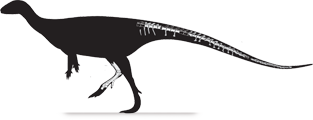
Until 2018, three ornithopods had been named from the upper Aptian–lower Albian deposits in Victoria (Leaellynasaura and Atlascopcosaurus from the Eumeralla Formation in the Otway Basin and Qantassaurus from the Wonthaggi Formation in the Gippsland Basin), but all of their holotypes consist solely of skull fragments, with only Leaellynasaura being bolstered by non-skull fossils, which it was relieved of in 2016. Diluvicursor bucked that trend by being assigned a virtually complete tail and a partial lower leg but no skull material when it became Victorian ornithopod number four in 2018, which may sound great, at least to swift-running herbivorous dinosaur fanatics... but it isn't. It lacks any fossils that can be compared to the other currently named Victorian ornithopods, and the skeletal specimens that were recently removed from Leaellynasaura that it can be compared to are different in having a far longer tail and less robust feet. Whether or not Diluvicursor is synonymous with any of the previously mentioned critters can only be determined from future discoveries of associated remains with overlapping parts for comparison, so, at least for now, it's valid by default.
(Pickering's deluge runner)Etymology
Diluvicursor is derived from the Latin "diluvi" (deluge or flood), in reference to both the high-energy river within which the type specimen was deposited and the river-caused floodplain where the species lived during the Early Cretaceous, and the Latin "cursor" (runner).
The species epithet, pickeringi, honors David A. Pickering, for his significant contribution to Australian palaeontology, and in memory of his passing during the time Diluvicursor was being studied, following complications after a serious car accident.
ZooBank registry: urn:lsid:zoobank.org:act:9E1765D7-756F-4CF2-A005-EC0B0BE996BA.
Discovery
The first remains of Diluvicursor were discovered in the Eumeralla Formation (Otway Group) at the "Eric the Red West" site, near Cape Otway, southern Victoria, southeastern Australia, by George Caspar in 2005.
The holotype (NMV P221080) is an almost complete tail and partial lower right hindlimb, excavated and reported by Rich et al in 2009 as a possible ornithopod that had been buried in sediments of a fast-flowing river after becoming entangled in a ‘trap’ of plant debris that accumulated around an upright tree stump. Referred material includes a tail vertebrae (NMV P229456) from the holotype site.
Preparators
Lesley Kool of Monash University and
David A. Pickering (RIP) of Museums Victoria.


