









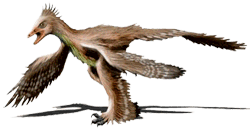
Pronunciation: shyow-TIN-gee-uh
Meaning: for Zheng Xiaoting
Author/s: Xing Xu (2011)
Synonyms: None known
First Discovery: Liaoning, China
Acta Ordinal: #774
Xiaotingia zhengi
After Darwin's "On the Origin of Species" in 1859 and the discovery of Archaeopteryx — a fossil caught in the act of evolution a couple of years later to support his then-ludicrous theory — the "first bird" slot seemed to be sewn up. But 150 years later, Xiaotingia landed on news desks virtually begging for cheesey "Archaeopteryx knocked off its perch" headlines, or so confused reporters thought, and the general public hit stages one, two and four of the five stages of grief. However, Xioaotingia is innocent.
Apparently, Xing Xu used an old matrix that lacked two sets of critical updates during his analysis of small dinosaurs, "dino-birds" and dinosaurs that may or may not be close to birds, and managed to redefine the concepts of Avialae (birds) and Deinonychosauria (the sickle-clawed carnivorous dinosaurs affectionately known as "raptors") to such an extent that the newly discovered Xiaotingia, Archaeopteryx and Anchiornis were all pounded into the same clade: Archaeopterygidae. Anchored by Archaeopteryx and historically placed within birds, Xu then proceeded to plonk his archaeopterygids amongst the deinonychosaurs, and this was when the pros became vexed too.
Retaliation was swift as palaeontologists shot this theory down in flames, and even Xu's revised version of his initial analysis ("tentative" as it was) showed that he got it horribly wrong first time 'round. As predicted, Archaeopteryx is a basal bird again, Anchiornis is back to being a troodontid, and Xiaotingia is the most primitive known dromaeosaurid, at least according to the latest round of research by Phil Senter et al.
Apparently, Xing Xu used an old matrix that lacked two sets of critical updates during his analysis of small dinosaurs, "dino-birds" and dinosaurs that may or may not be close to birds, and managed to redefine the concepts of Avialae (birds) and Deinonychosauria (the sickle-clawed carnivorous dinosaurs affectionately known as "raptors") to such an extent that the newly discovered Xiaotingia, Archaeopteryx and Anchiornis were all pounded into the same clade: Archaeopterygidae. Anchored by Archaeopteryx and historically placed within birds, Xu then proceeded to plonk his archaeopterygids amongst the deinonychosaurs, and this was when the pros became vexed too.
Retaliation was swift as palaeontologists shot this theory down in flames, and even Xu's revised version of his initial analysis ("tentative" as it was) showed that he got it horribly wrong first time 'round. As predicted, Archaeopteryx is a basal bird again, Anchiornis is back to being a troodontid, and Xiaotingia is the most primitive known dromaeosaurid, at least according to the latest round of research by Phil Senter et al.
(for Zheng Xiaoting)
Etymology
The generic name (Xiaotingia) honours Zheng Xiaoting, founder of the Shandgong Tianyu Museum of Nature, and funnily enough, so does the species epithet, zhengi.
ZooBank registry: urn:lsid:zoobank.org:act:FA77146D-0E18-4A28-B3EB-08F133FDECB5.
Discovery
The remains of Xiaotingia were discovered in the Tiaojishan Formation at Daxishan village, Linglongta, Jianchang County, western Liaoning, China.
The holotype (STM 27-2) is an almost complete skeleton including a skull. Its teeth are more bulbous than those of its closest relatives, which suggests it may have eaten plants or small shellfish, or both.
Preparators
T. Yu


