


Pronunciation: AR-a-lo-SOR-us
Meaning: Aral Sea Lizard
Author/s: Rozhdestvensky (1968)
Synonyms: None known
First Discovery: Qyzylorda, Kazakhstan
Acta Ordinal: #222
Aralosaurus tuberiferus
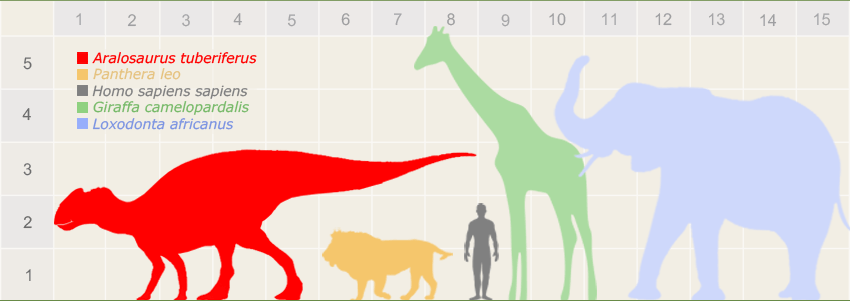
Russian paleontologists found what would come to be known as Aralosaurus on the shores of a receding Aral sea in 1957, but since then its remains have receded somewhat too. It was initially assigned several vertebrae, bones from the forearms and fragments of a leg and foot. Unfortunately, they're long lost, and the only fossil it can seriously lay claim to is a partial skull that's broad at the back and built to anchor massive muscles to power its chewing tools: jaws packed with hundreds of small teeth set in 30 or more interlocking banks to form huge dental batteries.
Once thought to be a Gryposaurus-like saurolophine hadrosaurid because of an arch on its snout formed by a pair of raised nasal bones, later research led Pascal Godefroit to conclude that Aralosaurus is actually the most basal lambeosaurine. In 2013, Prieto-Márquez nominated Aralosaurus to co-anchor a lambeosaurine tribe known as Aralosaurini, along with Canardia garonnensis, because they both sport a similar peak on the topside-rear of the bony crest which adorns their broad snout.
Once thought to be a Gryposaurus-like saurolophine hadrosaurid because of an arch on its snout formed by a pair of raised nasal bones, later research led Pascal Godefroit to conclude that Aralosaurus is actually the most basal lambeosaurine. In 2013, Prieto-Márquez nominated Aralosaurus to co-anchor a lambeosaurine tribe known as Aralosaurini, along with Canardia garonnensis, because they both sport a similar peak on the topside-rear of the bony crest which adorns their broad snout.
Etymology
Aralosaurus is derived from "Aral" (for the Aral Sea) and the Greek "sauros" (lizard). The Aral Sea is actually a huge inland lake in central Kazazhstan which was once top four in the world, size-wise, at almost 68,000 km square, but it's been gradually shrinking since the 1960's when the Soviet Union began redirecting feeder rivers and messing with irrigation. The species epithet, tuberiferus, means "bearing a tuber" because of the bony arch (or tubercle) on its snout.
ZooBank registry: urn:lsid:zoobank.org:act:966EE15D-31CA-4C06-8D78-BC007482F2F0.
Discovery
The remains of Aralosaurus were discovered at "Sakh-Sakh" in the Bostobe Formation (previously the Beleutinsk Formation or Beleutinskaya Svita), Qyzylorda, central
Kazakhstan, in 1957.The Holotype (No. 2229/1) is an incomplete skull.