




Pronunciation: san-hwan-SOR-us
Meaning: San Juan lizard
Author/s: Alcober and Martinez (2010)
Synonyms: None known
First Discovery: San Juan, Argentina
Acta Ordinal: #755
Sanjuansaurus gordilloi
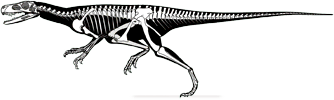
Sanjuansaurus was discovered in the Ischigualasto, a fossil-rich Argentine rock Formation that has also yielded remains of Eoraptor, Panphagia, Herrerasaurus (plus its synonyms Ischiasaurus and Frenguellisaurus), both carnivorous and herbivorous cynodonts, rhynchosaurs, and crurotarsan archosaurs. The entirety of its remains were found in a plot just a single meter square, but this has no bearing on its total dimensions; its remains are meagre, but the lay of the bones, plus their state of preservation and lack of duplicate elements, suggest they do belong to the same individual.
In size, Sanjuansaurus seems to sit somewhere between fellow herrerasaurids Herrerasaurus and Staurikosaurus and is similarly proportioned, but is unique in sporting a very short pubis bone (63% of its thigh length) that's angled forwards rather than pointing straight down. Although Sanjuansaurus is very Herrerasaurus-like in features, paleontologists can tell the former from the latter by its narrower shoulder blade, shorter and more slender fingers, features of its hip, and more gracile build. Unfortunately, finding its family (Herrerasauridae) a stable position to rest their old bones has proven troublesome.
Where herrerasaurids lie on the dinosaur family tree is no more certain now than it was when the family name was coined, and it was coined way back in 1973! They have been recovered as everything from very basal theropods to basal saurischians, more primitive critters that pre-date the saurischian-ornithischian split, and even an early lineage of sauropodomorphs. Somewhere at the foot of Theropoda is the current popular opinion, with a position in Sauropodomorpha the least likely.
In size, Sanjuansaurus seems to sit somewhere between fellow herrerasaurids Herrerasaurus and Staurikosaurus and is similarly proportioned, but is unique in sporting a very short pubis bone (63% of its thigh length) that's angled forwards rather than pointing straight down. Although Sanjuansaurus is very Herrerasaurus-like in features, paleontologists can tell the former from the latter by its narrower shoulder blade, shorter and more slender fingers, features of its hip, and more gracile build. Unfortunately, finding its family (Herrerasauridae) a stable position to rest their old bones has proven troublesome.
Where herrerasaurids lie on the dinosaur family tree is no more certain now than it was when the family name was coined, and it was coined way back in 1973! They have been recovered as everything from very basal theropods to basal saurischians, more primitive critters that pre-date the saurischian-ornithischian split, and even an early lineage of sauropodomorphs. Somewhere at the foot of Theropoda is the current popular opinion, with a position in Sauropodomorpha the least likely.
(Raul Gordillo's San Juan Lizard)Etymology
Sanjuansaurus is derived from "San Juan" (its area of discovery) and the Greek "sauros" (lizard).
The species epithet, gordilloi, honors Raul Gordillo - head fossil preparator and artist of the San Juan Museum.
ZooBank registry: urn:lsid:zoobank.org:act:DC75ADA0-0C6B-41D5-8E29-CD76725FD704.
Discovery
The remains of Sanjuansaurus were discovered at "La Gallinita" (aka "Herrera de la base") in the lowest levels of the Cancha de Bochas Member of the Ischigualasto Formation, San Juan, Argentina, by workers from the Instituto y Museo de Ciencias Naturales of the Universidad Nacional de San Juan in 1994.
The holotype (PVSJ 605) includes most of the vertebral column, both shoulder blades, a forearm bone (ulna), a partial pelvis, some leg bones, a jaw fragment, and other bits and bobs.


