









Pronunciation: ag-nohs-FIE-tis
Meaning: Unknown begetter
Author/s: Fraser et al. (2002)
Synonyms: None known
First Discovery: Avon, England
Acta Ordinal: #512
Agnosphitys cromhallensis
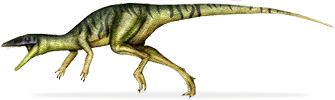
Although disputed by some, Agnosphitys (also mispelled Agnostiphys and Agnosphytis) seems to lie close to the ancestry of dinosaurs, but the whereabouts of its bed isn't exactly clear. Deciphering extinct critters and working out where they belong on the tree of life is always fraught with uncertainty, but sometimes the stars will align and a combination of closely associated remains, solid fossils and plain old luck will make palaeontologist's lives so much easier. Sadly, Agnosphitys wasn't blessed with any of those things. The coining authors even chose a name that means name "unknown begetter", because they had no idea what begot it nor what it begot.
Among dis-articulated and randomly assigned remains, its holotype ilium (part of the pelvis) sports a deep groove (brevis fossa) found in dinosaurs, a maxilla (upper jaw bone) may be theropodan... or lack any dinosaurian features depending on which scientist you follow, a humerus ("funny" bone) and astragali (two ankles) are distinctly dinosaurian though don't necessarily belong to the same dinosaur, and its two sacral (hip) vertebrae are one short of the minimum found in dinosaurs. The odd tooth could belong to absolutely anything.
Unsuprisingly, Agnosphitys is a nightmare to classify. Depending on how Dinosauria is defined, it is either a small primitive meat-eating dinosaur, one of the dinosaur's closest non-dinosaur relatives known as dinosauriformes, or possibly a guaibasaurid: the most primitive group of sauropodomorphs that were small, bipedal, probably omnivorous, and originally thought to be theropods. Given the uncertainty, we're plumping for "a primitive saurischian with impossible to classify chimaeric remains belonging to theropods and god knows what else", which pretty much sums it up.
Among dis-articulated and randomly assigned remains, its holotype ilium (part of the pelvis) sports a deep groove (brevis fossa) found in dinosaurs, a maxilla (upper jaw bone) may be theropodan... or lack any dinosaurian features depending on which scientist you follow, a humerus ("funny" bone) and astragali (two ankles) are distinctly dinosaurian though don't necessarily belong to the same dinosaur, and its two sacral (hip) vertebrae are one short of the minimum found in dinosaurs. The odd tooth could belong to absolutely anything.
Unsuprisingly, Agnosphitys is a nightmare to classify. Depending on how Dinosauria is defined, it is either a small primitive meat-eating dinosaur, one of the dinosaur's closest non-dinosaur relatives known as dinosauriformes, or possibly a guaibasaurid: the most primitive group of sauropodomorphs that were small, bipedal, probably omnivorous, and originally thought to be theropods. Given the uncertainty, we're plumping for "a primitive saurischian with impossible to classify chimaeric remains belonging to theropods and god knows what else", which pretty much sums it up.
(Unknown begetter from Cromhall)Etymology
Agnosphitys is derived from the Greek "agnos" (unknown) and "phitys" (begetter: a procreator or generator of offspring, normally referring to the male parent).
The species epithet, cromhallensis (krom-haw-LEN-sis) means "from Cromhall" in Latin, and refers to its discovery in Cromhall Quarry.
Discovery
The remains of Agnosphitys were discovered at the Cromhall Quarry, Avon, southwest England, in 1990, mingled with other disassociated tetrapod fossils that
include crocodylomorphs, rauisuchiforms and sphenodontians.
The holotype (VMNH 1745, housed at the Virginia Museum of Natural History in Martinsville) is a left ilium (the uppermost and largest bone of the hip). Referred material includes a partial left maxilla (tooth bearing bone of the upper jaw), a left and a right astragalus (ankle), a right humerus (upper arm bone) and a tooth.


