





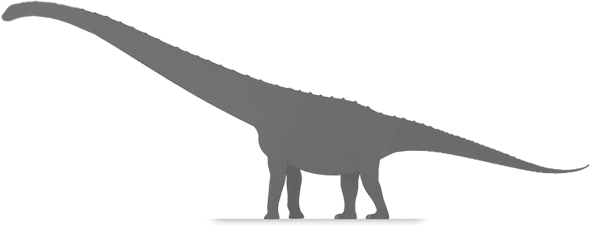
Pronunciation: ro-mah-LAY-oh-PAK-us
Meaning: Robust Forearm
Author/s: Upchurch et al. (2021)
Synonyms: None known
First Discovery: Xinjiang, China
Acta Ordinal: #1074
Rhomaleopakhus turpanensis
In 1993, fossils hauled from the Kalazha Formation in Xinjiang were named by Zhiming Dong as Hudiesaurus sinojapanorum—the "butterfly lizard", referring to the purported "wing-like" process on its neural spine. The material was fragmentary—a single vertebra designated as the holotype, with a forelimb and four teeth referred from a quarry nearly a kilometre away—and yet it was briefly heralded as the largest sauropod known from China. Much has changed since then.
(Robust Forearm from Turpan)Etymology
Rhomaleopakhus is derived from the ancient Greek "Rhomaleos" (robust) and "pakhus" (forearm).
The species epithet, turpanensis, is derived from "Turpan" (for China's Turpan Basin, where the holotype was found) and the Latin "-ensis" (from).
ZooBank registry:
urn:lsid:zoobank.org:act:FA936D72-7675-47A7-945F-4FA1D52B0374.
Discovery
The remains of Rhomaleopakhus were discovered in the Lower part of the Kalazha (aka Karaza, Kalaza, or Hongshan) Formation at Qiketai (aka Qiketia, or Qikatai) town, in the Turpan Basin of Shanshan County, Xinjiang Uyghur Autonomous Region of China, during the Sino-Japanese Silk Road dinosaur expedition in 1993.
The holotype (IVPP V11121-1) is a right forelimb—consisting of the humerus, ulna, radius, and one carpal—and a virtually complete hand from a single individual, which Zhiming Dong had referred to Hudisaurus sinojapanorum in 1997.


